No votes yet.
How to Extreme Coupon in 2026: A Step-by-Step Beginner’s Guide
Extreme couponing is still possible in 2026, and it’s almost entirely digital. This guide covers how to extreme coupon step by step, from stacking manufacturer and store coupons to picking the right apps and stores. Beginners can expect $50-$150/month in savings within the first few months.
You’re standing in the checkout line, watching the total drop. $72. $58. $41. $23. The cashier raises an eyebrow. You just smile. That’s extreme couponing in a nutshell, and in 2026, almost all of it happens on your phone before you even leave the house.
Key Takeaways
- ✓ Extreme couponing is still very much alive in 2026, but it’s now almost entirely digital. Over 93% of coupon redemptions happen on a smartphone.
- ✓ The core skill is stacking: combining a sale price + manufacturer coupon + store coupon + rebate app on the same item. Done right, this can slash 70-90% off a single trip.
- ✓ Beginners typically save $50-$150/month in the first 3 months. Committed extreme couponers reach $500-$800/month after a year or two.
- ✓ CVS and Target are the most beginner-friendly stores. Walmart doesn’t allow stacking but does honor coupon overage.
What Is Extreme Couponing (and Is It Still Possible in 2026)?
Extreme couponing means stacking multiple discounts on the same item until you’ve cut your bill by 50 to 90 percent. Every layer you add brings the price down further. That TLC show made it look like people with warehouses of cereal. Some couponers still do that. But most who do this seriously just shave hundreds of dollars off their monthly grocery bill with 2-3 hours of prep per week.
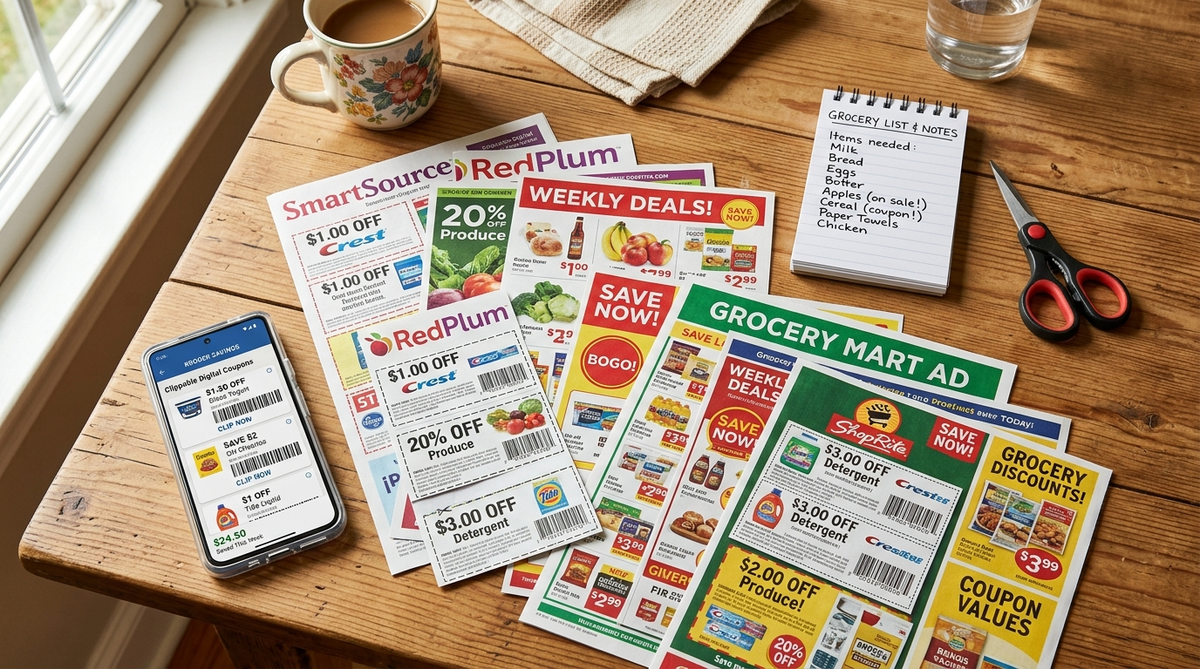
So is it still possible? Yes, but it looks different now. Paper coupon inserts have largely disappeared. Save brand is the only major provider still printing Sunday inserts, after SmartSource stopped. That makes digital platforms the main source for coupons. And that’s good news for beginners. Digital coupons are easier to find and use than a paper binder.
The size of the digital coupon world explains why this still works. Over 93% of coupon redemptions in 2026 happen via smartphone. The digital coupon market is worth over $10 billion. Mobile coupons get redeemed 10 times more often than paper ones. Stores have built serious digital deal systems to compete, which means more offers available than ever. Just in app form now, not on newsprint.
What should you realistically expect? The typical U.S. household could save about $1,465 per year by consistently using coupons. Extreme couponers can push that to $6,000-$9,600 annually. It takes time to build up to those numbers, but the ceiling is real and the savings add up fast.
How Much Can You Actually Save? Realistic Expectations by Skill Level
Beginners save $50-$150 per month in the first few months, experienced couponers hit $200-$400/month, and extreme couponers can reach $500-$800 or more per month once they’ve mastered the system.
Here’s the breakdown by stage:
Beginner (months 1-3): You’re still learning which apps to use, how stacking works, and which stores have the best rules. Expect 25-40% off your grocery bill on good trips. That’s roughly $50-$150/month in savings based on household size.
Intermediate (months 4-12): The routine is set. You match coupons to weekly sales and use rebate apps on every receipt. Savings in the 50-60% range become the norm. Monthly savings climb to $200-$400.
Expert/extreme (year 2+): This is where the big numbers happen. Trips hitting 70-90% off are doable when you stack a sale, a brand coupon, a store coupon, and a rebate app on the same item. One real-world example: a couponer saved $720.86 in a single month. Do that all year and it’s nearly $8,650 back in your pocket.
Point is, most people don’t start there. Data from coupon usage research shows that 4% of coupon users save more than $100/month, while 23% save $25-$50/month. Starting in that middle range and building from there is the realistic path.
Monthly Savings by Couponing Skill Level
Estimated savings per month, based on consistent couponing effort (upper bound used for bar width)
Beginner (months 1-3)$50-$150/mo
Intermediate (months 4-12)$200-$400/mo
Expert/Extreme (year 2+)$500-$800/mo
Top extreme couponers: up to $8,650/year in documented savings
Step 1: Learn the Two Types of Coupons (and How Stacking Works)
Every extreme couponer needs to know one basic rule: there are two types of coupons, and you can usually use both on the same item.
Manufacturer coupons are issued by the brand, think Tide, Pampers, Colgate. The barcode starts with a 5. They work at any store that carries the product. The store gets paid back by the manufacturer later. You find them in store apps, coupon databases, or brand apps.
Store coupons are issued by the retailer. CVS ExtraCare coupons, Target Circle offers, Walgreens digital coupons. The barcode starts with 4. They’re only valid at that specific chain, and the store eats the discount itself.
Stacking means using one of each on the same item at the same time. Most big retailers allow this: one manufacturer coupon plus one store coupon per item. But it doesn’t stop there. The real power move is adding a sale price and a rebate app on top too.
Here’s a real example. Take an $8 box of diapers on sale for $6. Use a $2 brand coupon and a $1 store coupon, and you’re at $3. Scan the receipt in a rebate app and get $1.50 back. Final cost: $1.50. That’s 81% off a name-brand product, no tricks, no rare deals.
What most guides miss is that the rebate app layer is where beginners leave the most money. Tracking deals across hundreds of stores, we see shoppers who learn stacking but skip the post-purchase step. That’s $15-$30 per trip left on the table. The rebate scan takes 30 seconds. Do it every time.
💡
Tip: Always stack in this order: find the sale price first, then match a manufacturer coupon to it, then look for a store coupon, then add your rebate app. Starting with the coupon and working backward often means you miss the sale price layer entirely.
Step 2: Download the Right Apps and Tools
You don’t need 15 apps. You need the right 4-5, set up properly from day one.
Store apps (start here): Download the app for each store you plan to use. Target Circle, CVS ExtraCare, Walgreens, Kroger, and Walmart all have apps where you clip digital coupons before your trip. These are also where store-only deals live that you can’t get anywhere else.
Rebate apps (second layer): These pay you back after you buy. Fetch Rewards works with any grocery receipt and turns points into gift cards, no clipping needed. Checkout 51 runs weekly cash-back deals on specific items. Shopkick gives points for scanning items in-store, even if you don’t buy.
Coupon databases: Sites like DontPayFull pull together coupons and promo codes from thousands of stores. No need to check five sources on your own. For online shopping, a browser extension that tests codes at checkout automatically handles that step for you.
The 2026 shift here is AI-powered tools that track prices and flag the best moment to buy. These work great for non-grocery items like electronics and home goods.
Our advice to a total beginner: pick one store app, one rebate app, and one coupon site to start. Get used to those three before adding more. The couponers who try to run eight apps at once usually quit by week three.
3
Apps to start with
30s
To scan a receipt
93%+
Digital redemptions
Step 3: Pick Your First Store (Best Stores for Extreme Couponing)
What store is best for extreme couponing? CVS and Target are the top picks for beginners, but each major chain has a different stacking policy worth knowing before you walk in.
CVS is the couponing favorite for many experienced shoppers. The ExtraCare program gives you ExtraBucks (ECBs) that roll forward. You earn store credit by buying qualifying items, then use that credit on your next trip. Stack manufacturer coupons on top and CVS trips regularly hit “moneymaker” deals where your net cost drops to zero. The CVS coupons page keeps running offers you can layer on top of in-store deals.
Target rewards beginners with the most forgiving system. Target Circle digital offers stack with manufacturer coupons. Got a RedCard? That’s another 5% off on top. Target also runs gift card promotions where buying a product earns you a $5 or $10 gift card. That’s a third discount layer. Browse current Target deals to match them up before your next trip.
Walgreens runs a rolling rewards program through its Walgreens Cash system. Register Rewards (RRs) print after qualifying buys and work like cash on your next order. Stack them with manufacturer coupons and you’ll find near-free deals on personal care items regularly.
Kroger allows up to 5 uses of a digital coupon per transaction during its Mega Events. That makes stocking up fast when a strong deal runs. Fuel points calculate before coupons apply, so you get full credit even when you pay very little at checkout.
Walmart doesn’t allow stacking the way CVS or Target does. But Walmart honors coupon overage: if a coupon’s value beats the item’s price, the extra comes off your total. That’s a useful quirk to know. Check current Walmart deals before any big household run.
Dollar General is a sleeper pick. Its $5 off $25 Saturday DG coupon stacks with brand coupons, and Dollar General runs some of the best cleaning supply and paper towel deals around.
| Store | Stack Manufacturer + Store? | Special Perk | Beginner Friendly? |
|---|---|---|---|
| CVS | Yes | ExtraBucks rolling rewards | Yes |
| Target | Yes | RedCard 5% + gift card deals | Yes (best pick) |
| Walgreens | Yes | Register Rewards system | Moderate |
| Kroger | Yes | 5x digital coupon uses per trip | Moderate |
| Walmart | No stacking | Honors coupon overage | Limited |
| Dollar General | Yes | $5 off $25 Saturday coupon | Yes |
Our pick: start at Target or CVS. Both have solid apps, clear rules, and cashiers who’ve dealt with couponers before.
Step 4: Build Your Weekly Couponing Routine
Extreme couponing without a routine is just chaos with a receipt. The time investment is real, but it’s manageable once you have a system.
Sunday: Browse the week’s store ads. Most sale cycles run Wednesday through Tuesday, so Sunday is when you can see what’s coming. Clip digital coupons in your store apps so they’re ready when you go.
Monday-Tuesday: Match coupons to the sales you found. Check what’s on sale. Find out if a brand coupon exists for that item. Note where the stack looks good. A grocery list app keeps it all organized.
Wednesday or Thursday: Shop early while shelves are full. Popular coupon deals sell out by the weekend at busy stores.
Time investment for beginners runs about 2-3 hours per week. Once you know your stores and have a coupon-matching rhythm, experienced couponers often manage this in 1-2 hours.
The binder system from old TLC clips is mostly gone now. Your phone is the organizer. Use the “favorites” or list features in each app to stage what you plan to buy, and check expiry dates before you leave.
🤔
Did You Know: Most store sale cycles start on Wednesday, not Sunday, despite Sunday being the traditional coupon insert day. Shopping early Wednesday morning gives you the best combination of fresh sales and full shelves.
Step 5: Master the Art of Stockpiling
The strategy behind extreme couponing isn’t buying what you need right now. It’s buying what you’ll need later, at the lowest price you’ll ever see.
Stockpiling means buying items at their lowest price, even if you already have 3 months of supply. This works best for nonperishables: canned goods, cleaning supplies, paper products, and personal care items. They last long and their prices follow a predictable cycle.
Buy only what you’ll realistically use before expiration. This sounds obvious, but it’s the rule most beginners break. A closet full of expired products isn’t savings.
Storage is simple: a dedicated shelf or closet, organized with the oldest stock at the front. Rotate when you add new items. The best stockpile opportunities appear when a “buy X get Y free” promotion overlaps with a manufacturer coupon and a sale price at the same time. These create near-free or actually free items on specific weeks.
Annual patterns worth knowing: school supply deals peak in mid-summer. Toiletry deals cluster after major holidays when stores clear stock. From our coupon database, the free-after-stacking deals show up most often in personal care. Razors, shampoo, and body wash hit free or near-free regularly because brand coupon values run high for those items.
Common Coupon Lingo Every Beginner Should Know
Walk into a couponing forum without knowing this vocabulary and you’ll be lost. Here are the terms that come up constantly:
BOGO – Buy One Get One Free. Can also appear as BOGO 50%, meaning the second item is half price.
MIR – Mail-in Rebate. Less common now than in the pre-digital era, but still shows up for certain electronics and auto products.
OYNO – On Your Next Order. A coupon you get at checkout that comes off your next trip, not this one.
ECB – ExtraCare Bucks. CVS store credit you earn by buying certain products. Use it on a future trip.
RR – Register Rewards. Walgreens’ equivalent. Prints at the register after qualifying purchases.
MQ / SQ – Manufacturer Coupon / Store Coupon. Short forms used in deal forums to note which type of coupon applies.
Moneymaker – A deal where the combined discounts wipe out the price and leave you with store credit. You end up ahead. These are real.
Overage – When a coupon value exceeds the item’s price. Walmart applies this overage to your cart total. Most other stores don’t.
IP – Internet Printable. A coupon printed from a website rather than clipped from a newspaper.
Coupon Ethics: Rules Every Extreme Couponer Should Follow
Is extreme couponing illegal? No. Couponing is fully legal. Coupon fraud is the crime. Retailers lose an estimated $2.8 billion per year to it. The line between smart couponing and fraud isn’t hard to see, but it’s worth knowing clearly.
Never photocopy or reproduce coupons. A photocopied coupon is a counterfeit coupon, full stop. This applies to digital screenshots too.
Don’t clear shelves. Buying every unit of a product because you have 20 coupons is selfish. Other shoppers need those items too. Most store policies and coupon fine print limit purchases for this reason.
Read every coupon’s fine print. Limits like “one coupon per transaction” or “one coupon per household” are real restrictions. Ignoring them isn’t clever couponing.
Bring the store’s coupon policy. Most stores post their coupon rules online as a PDF. Save it to your phone. When a cashier questions a stack, showing the written policy solves most problems fast. No arguing needed.
The community rep matters too. Stores that get hit by coupon fraud tighten their rules for everyone. Being ethical keeps the good deals alive for all couponers.
Your First Extreme Couponing Trip: A 10-Item Challenge
Don’t start by hitting three stores with 40 coupons. That’s how people burn out in the first week.
Start with just 10 sale items at one store. Target or CVS work well. Before you go, match each item to at least one coupon. Use a store digital coupon from the app or a brand coupon from DontPayFull. Load your rebate app and link it to your account so you can scan the receipt after you pay.
The goal isn’t maximum savings. The goal is learning the process. How does the coupon scan? Does the discount show up on screen? What happens if one doesn’t work? Getting the hang of it on a small trip is worth more than trying to save every cent on trip one.
After checkout, open your rebate app immediately and scan the receipt. Most apps have a short submission window, and you don’t want to forget.
Then calculate your total savings against full retail price. That percentage is your baseline. Every trip after this, you’re trying to beat it.
The Bottom Line
Extreme couponing in 2026 is real, digital, and accessible to beginners. The core system is stacking: combine a sale price with a manufacturer coupon, a store coupon, and a post-purchase rebate scan on the same item, and you can routinely cut 50-80% off your grocery bill. Beginners should expect $50-$150/month in savings within the first few months; committed extreme couponers reach $500-$800/month after a year. Start at CVS or Target, download 2-3 apps, build a Sunday-to-Wednesday weekly routine, and do a 10-item practice run first. The technique takes a few weeks to click. After that, the savings compound fast.
Frequently Asked Questions
What is the trick to extreme couponing?
The trick is stacking. Most couponers use one coupon on one item. Extreme couponers layer a sale price plus a brand coupon plus a store coupon plus a rebate app on the same item. Each layer is small on its own. But stacked together, they cut 70-90% off. The second trick is timing: buy items when they’re on sale, not just when you need them.
Is it still possible to do extreme couponing in 2026?
Yes, but it looks different from the TLC show era. Paper coupon inserts have largely disappeared, with Save brand being the only major national insert still in print. Everything has moved to store apps, coupon databases, and rebate apps. The savings potential is the same or higher. The tools are just digital now.
Is extreme couponing illegal?
Extreme couponing is fully legal. Coupon fraud is the crime. That means photocopying coupons, using them on wrong items, or exploiting glitches. Standard stacking and rebate apps are normal retail practices. Most stores have coupon policies that spell this out.
What store is best for extreme couponing?
For beginners, Target is the best place to start. The app is easy, Circle offers stack well with brand coupons, and the RedCard adds 5% off on top. CVS is the better long-term pick for grocery and personal care savings, thanks to the ExtraBucks system. Walgreens, Kroger, and Dollar General all have good deal setups once you know their rules.
How much time does extreme couponing take per week?
Beginners spend about 2-3 hours per week. One session to browse ads and clip coupons, one to match deals to a list. Once you know your stores, you can do it in 1-2 hours. The time keeps shrinking as the routine kicks in.
Can you still use paper coupons in 2026?
Yes, but with fewer sources than before. Save brand is now the only major provider of printed Sunday inserts, after SmartSource stopped. Some brands still mail paper coupons or put them in product packaging. But store app coupons are the main format now, accounting for over 33% of all redemptions worldwide, versus 24.2% for newspaper inserts.
Sources
- affmaven.com coupon statistics: Data on coupon redemption rates, smartphone usage, and saver demographics (2026)
- ABC15 Arizona consumer spending study: Annual household savings from consistent couponing
- Bree Coupon Queen, YouTube: Documented single-month savings of $720.86 from extreme couponing
- demandsage.com: Retailer losses to coupon fraud ($2.8 billion annually)
Do You Have Any Suggestions?
We're always looking for ways to enrich our content on DontPayFull.com. If you have a valuable resource or other suggestion that could enhance our existing content, we would love to hear from you.
Was this content helpful to you?
Related Articles