5.00 out of 7 votes
How to Negotiate Prices: Scripts and Strategies for Everyday Purchases
Most people leave money on the table simply because they don’t ask. This guide shows how to negotiate prices in the categories where it works best, with word-for-word scripts for cars, hotels, medical bills, and recurring bills. Backed by research showing 89% who try haggling get a better deal.
What if the price tag in front of you was just a starting suggestion?
For most people, it isn’t. The sticker price feels final. Asking feels awkward, maybe even a little embarrassing. So they pay it. And they leave money on the table every single time.
Here’s what makes that worth talking about: a 2025 study by Indiana University and Cornell researchers found that 95% of individuals skip negotiation up to 51% of the time. That’s across five studies and 5,881 Americans. Nearly half said they’d pay more just to avoid the conversation. But Consumer Reports polling found that 89% of Americans who tried haggling were rewarded at least once. The gap between those two numbers is basically a wall of cash people are walking past every day.
This guide covers how to close that gap. We’re talking category-specific scripts, the right timing, how to negotiate online, and a few tactics that don’t show up in any generic negotiation article.
Key Takeaways
- ✓ 89% of Americans who tried negotiating got a better price at least once, per Consumer Reports data.
- ✓ 95% of people skip negotiation up to 51% of the time, meaning most savings opportunities go unclaimed.
- ✓ Check DontPayFull for active coupon codes before you negotiate. Knowing what a store already offers gives you a factual anchor.
- ✓ High-success categories include cable/internet bills, hotel rates, medical bills, and big appliances. Electronics are tougher.
- ✓ Timing matters: end of month, end of season, and new model releases all create natural negotiating windows.
Why Most People Never Ask (And Why That Costs Them)
Most consumers skip negotiation not because they think it won’t work. They skip it because asking feels uncomfortable. Research from IU Kelley School of Business is pretty clear on this: businesses can raise prices 5% to 11% and most consumers just pay it. On average, people need to believe they’d save 21% to 36% of an item’s price before they’ll even consider asking.
That threshold is the problem. Most negotiation opportunities aren’t offering 30% off. They’re closer to 5% to 15%. So people look at the gap, decide it’s not worth the discomfort, and pay full price.
But the math changes when you zoom out. A $25 monthly savings on a cable bill-that’s $300 a year. A $400 reduction on an appliance takes 10 minutes. An $800 discount on a used car takes one question. These aren’t huge individual wins. But they stack. The 49.7% of adults who report Willingness to Pay to Avoid Negotiation are essentially paying a recurring tax on their own discomfort.
89%
Hagglers rewarded at least once
51%
Of opportunities people skip
49.7%
Pay more just to avoid asking
And here’s the other thing: a no is rarely permanent. It usually means “not right now” or “not from me.” Front-line staff often can’t approve discounts on their own. Managers can. Timing matters. So does how you ask.
The 5 Golden Rules of Price Negotiation
These five rules apply whether you’re negotiating a car price, a hotel rate, or a recurring bill. They’re not magic scripts. They’re the framework that makes every other tactic in this article work.
Rule 1: Research first. You can’t anchor a deal without knowing the market. Check competitor prices, look up the price history, and search for active coupon codes on DontPayFull before you go in or call. A store that’s already running 10% off sitewide is telling you something about how much they’re willing to move.
Rule 2: Be friendly, not pushy. Deals that fall apart usually start with someone acting like the salesperson wronged them personally. The person you’re talking to can say yes or no. Being polite costs nothing and often tips things your way.
Rule 3: Start higher than your real target. If you want 15% off, ask for 20%. That gives you room to meet in the middle and still land where you wanted. Going straight to your real number leaves you no room to move if they push back.
Rule 4: Use silence. A Kellogg School of Management study of real eBay negotiations found that when a seller took twice as long as average to respond, the buyer was 6.3% less likely to keep pushing. The flip side works for you as a buyer too. When you pause before responding to a counteroffer, sellers are more likely to accept your price. Silence signals confidence. Don’t rush to fill it.
Rule 5: Be willing to walk away. For real. This is the one rule every competitor article mentions because it’s the one that actually gives you bargaining power. If the seller knows you’ll buy regardless, they have no reason to discount. Mean it when you say you’ll leave.
💡
Tip: Before any negotiation, spend 2 minutes on DontPayFull checking whether the store already offers a public coupon code. If they’re already advertising 15% off to new customers, you have a concrete number to reference in your conversation.
Step Zero: Check for Coupons Before You Negotiate
Most negotiation guides skip this entirely. It’s one of the most useful things you can do before opening your mouth.
When you check a store’s active coupon codes on DontPayFull, you learn two useful things. First, what discounts the store is willing to give. Second, what floor they’re likely to hold. A retailer running 20% off sitewide has already told you 20% is on the table. A store with no active codes at all is going to be a tougher conversation.
Tracking deals across hundreds of stores, a pattern keeps showing up: the retailers most willing to negotiate in person or over the phone are almost always the same ones running active promotions online. The promotional mindset runs through the whole operation. If a store is discount-averse, that usually shows in both places.
The workflow is simple. Search DontPayFull for the retailer. Note the best discount available right now. Then use that as your anchor. “I saw a 15% off code on your site. Is there any flexibility on the price here?” beats a vague “can you do better?” every time.
Price history data works the same way. If you can show that a specific item was $200 last month and is now $240, that price drop is your negotiating anchor. The conversation shifts from “can you discount this?” to “it was actually cheaper just a few weeks ago.”
🤔
Did You Know: Coupon and negotiation stacking is real. Apply a 10% discount code at checkout, then ask the chat agent if they can apply an additional loyalty or first-purchase credit on top. Some retailers say yes.
Negotiation Scripts for Everyday Purchases
This is the section most negotiation articles don’t have: specific, ready-to-use language organized by purchase type. Each script includes an opening line, a logical anchor, and a fallback ask if the first request gets a “no.”
Tone matters as much as the words themselves. Keep it curious and collaborative, not confrontational. You’re asking for help, not demanding a right.
Cars and Dealerships
Car prices are some of the most negotiable in everyday consumer life. Consumer Reports found that 78% of people who tried negotiating new car prices got a better deal. Used cars give you even more room, since the seller’s cost basis is harder to pin down.
Opening: “I’ve done some research and found this same model at [competitor dealership] for about $800 less. Is there any flexibility on your out-the-door price?”
Key rule: Negotiate the out-the-door total, not the monthly payment. Monthly payment negotiations are how dealers make up money on the back end through longer loan terms.
If they say no: Ask about free oil changes, extended warranty coverage, or accessories thrown in. Non-price concessions have real value.
Timing: The last 3 to 5 days of the month are noticeably better. Salespeople have monthly quotas, and a sale at the end of the month that closes the gap still counts. Visit on a Tuesday or Wednesday morning if you can. The showroom is quieter and you’ll get more attentive service.
Cable, Internet, and Phone Bills
This is the highest-percentage negotiation category for recurring bills, with success rates consistently above 80% for people who ask. The key is knowing which number to call.
Opening: “I’ve been a customer for [X] years and I’m seeing promotional rates for new customers at $[X] per month. I’d like to discuss bringing my rate in line with that, otherwise I may need to look at switching.”
Ask specifically for the retention department when you call. Regular customer service reps often can’t touch your pricing. Retention agents can. They’re authorized to offer discounts, bill credits, and promotional rates. Just saying “retention department, please” when someone picks up changes everything.
Timing: Call when your contract is expiring or when a competitor is running a promotion. That’s when you have the most natural clout in the conversation.
Hotel Rates
83% of hagglers got better hotel rates when they asked. That’s where this works best, because hotels save the 15% to 25% OTA commission when you book without a third-party platform. That savings is real and they know it.
Opening: “I see your rate online is $[X] per night. I’d like to book directly. Is there any flexibility on the rate for a direct booking?”
If the rate is firm: Ask for a room upgrade, complimentary breakfast, free parking, or a late checkout. These cost the hotel far less than a rate discount and they’re often willing to say yes.
Practical note: Call the property’s direct line, not the chain’s toll-free number. The person at the property can make decisions on the spot. Central reservations usually can’t.
Medical Bills
Medical bills are negotiable more often than most people realize, and the government has built consumer protections that give you real footing to push back.
Step one: Always request the itemized bill. Medical billing errors are common, and you can’t catch them without the line-by-line breakdown.
Opening: “I received this bill for $[X]. I’m in a position to make a prompt cash payment, and I’d like to discuss a settlement. Is $[X] something you can work with?”
Hospitals have financial assistance programs they don’t advertise. If you’re uninsured or the bill represents a hardship, ask specifically about charity care or financial assistance programs before negotiating a payment plan.
The Consumer Financial Protection Bureau advises that you confirm the debt in writing, work out a realistic repayment plan, and get any agreed settlement on paper before you pay. That last step matters. Verbal agreements on medical bills don’t hold up.
The No Surprises Act also gives consumers the right to dispute unexpected out-of-network charges. Got emergency care from an out-of-network provider without notice? That bill may be disputable.
Retail Stores and Big-Ticket Items
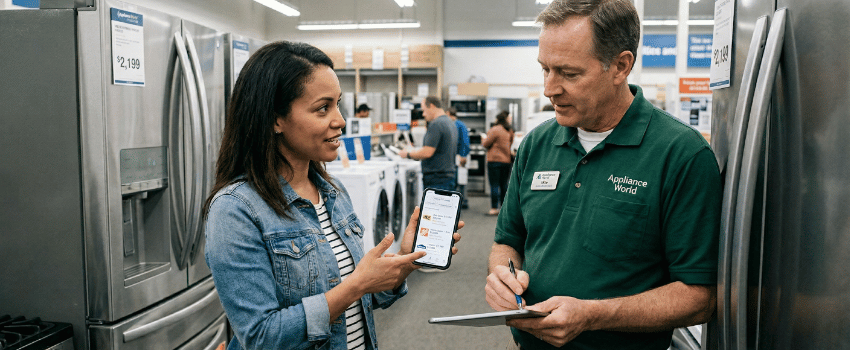
Appliances and mattresses are two categories where in-store negotiation works most reliably for everyday shoppers. Consumer Reports polling found 66% success on major appliances and 61% on mattresses.
Opening: “I noticed this is last season’s model. What’s the best you can do on the price?”
That framing works because it’s factual and it gives the salesperson a face-saving reason to discount. They’re not cutting the price because you pressured them. They’re moving older inventory. Different thing psychologically.
Always ask about floor models, open-box items, and price-match policies. Floor models at Best Buy or furniture showrooms are often 15% to 30% off, warranty still intact. Before invoking a price match, check DontPayFull or the competitor’s site to confirm the lower price is live right now.
Rent
Renters have more negotiating power in the current market than at almost any point in the past decade, especially in metro areas where vacancy rates have climbed. Use it.
Opening: “I love this apartment and I’m planning to stay long-term. I’ve found comparable units in the area for around $[X] per month. Is there any flexibility on the renewal rate?”
If the landlord won’t move on rent, pivot to concessions: one month free, free parking, a paint refresh, or waived pet fees. These all have real dollar value.
Start this conversation 60 to 90 days before renewal, not two weeks out. Early timing shows you’re serious. And it gives the landlord time to think twice before hunting for a new tenant.
How to Negotiate Online and Over Chat
This is the gap every negotiation article has missed. Almost all of them assume you’re in person or on the phone. But a big chunk of modern spending happens in chat windows, email threads, and online price-match forms. Different channel. Same principles.
Live chat script: “Hi, I’m considering purchasing [item] but I found a lower price at [competitor] for $[X]. Is there anything you can do to match that or get closer to it?”
Keep it short. Chat agents are handling multiple conversations. A clear, specific request with a concrete competing price gets processed faster than a vague ask.
Email template: Email works better for big purchases or when you need a paper trail. Be a bit more formal than chat. State the item, the competing price, and ask directly if they can match or beat it. Subject line: “Price Match Request: [Item Name].”
Price-match request forms: Most big retailers have these. Before you submit, get the live price from the competitor’s site, grab the product URL, and take a screenshot. The form will ask for this upfront.
Subscription cancellation trick: For software and streaming services, starting the cancellation process often triggers a retention offer. You’ll see discounts that never appear in the normal account menu. Start canceling, see what pops up, then decide.
When to Ask: Timing Your Negotiation for Best Results
The same exact ask, made at the wrong time, gets a different answer than at the right time. Timing is one of the most underrated factors in negotiation.
End of month: Sales teams have monthly quotas. A deal closed on the 30th counts just as much as one closed on the 1st. In the last 3 to 5 days of the month, salespeople who are short of their numbers are noticeably more willing to discount to close.
End of season: Retailers need to clear floor space for new inventory. The moment winter coats start arriving, last-season furniture is a negotiating opportunity. This applies to appliances, outdoor furniture, sporting goods, and seasonal electronics.
New model release: The instant a new product version is announced, the previous one becomes negotiable. You don’t have to wait for the new model to arrive. The announcement is enough. Dealers and retailers already know the older unit is about to be worth less.
Slow traffic times: Weekday mornings in a retail store mean fewer customers competing for staff attention. You’ll get more time, a better conversation, and a sales rep who has more room to work something out without a line forming behind you.
Deal calendar signals from DontPayFull: When a retailer rolls out a sitewide sale event on DontPayFull, it often signals the store is in a promotional mindset across the board. That’s a good time to walk in or call and ask for something extra on top of the published deal.
Negotiation Success Rates by Category
% of consumers who got a better deal when they asked (Consumer Reports)
Hotel Rates83%
New Car Purchases78%
Major Appliances66%
Mattresses61%
Any Category (tried at least once)89%
What to Do When They Say No
A no to your first ask is almost never the final answer. It’s usually “not that much” or “not my call.” Here’s what to do next.
First, ask to speak to a manager. This isn’t rude and it’s not an escalation. It’s just acknowledging that the person you’re talking to may not have authority to approve what you’re asking for. Front-line retail staff at most chains might not have the authority to approve more than a few dollars off without a supervisor.
Second, pivot to non-price asks. Extended warranty, free delivery, install included, a gift card, accessories thrown in. These often cost the retailer far less than a price cut but still have real value to you. Ask for them. Many stores say yes.
One tactic that works well: offer a range instead of a single number. Harvard PON research on bolstering ranges suggests putting your target at the favorable end of the range. Instead of “would you take $900?”, try “could you meet me somewhere between $850 and $950?” You signal flexibility. Not desperation.
Walking away is the last move, but sometimes the best one. Leave your contact info. Say something like “I really wanted to make this work. If anything changes, please reach out.” Two or three times out of ten, they call back with a better offer.
Negotiation Mistakes That Cost You the Deal
These are the patterns that kill negotiations before they get started. Knowing them matters as much as knowing the right script.
Making an offer without research. If you don’t know the market price, you have no anchor. The seller’s number becomes the default reference point. You’re negotiating down from their starting line instead of yours. Spend 5 minutes on price comparison first. It makes a real difference.
Starting with an apology. “Sorry to ask, but…” immediately signals that you expect to be told no. It also signals discomfort, which experienced sellers will absolutely use. Go in direct and friendly. No apology needed.
Accepting the first counter immediately. The moment you jump, the seller knows you had more room. And they’ll wonder if they should have offered less. If someone counters your $900 ask with $950, don’t say yes right away. Pause. Think out loud. Then decide.
Negotiating the monthly payment instead of the total price. This is the classic car and furniture financing trap. Monthly payment talks are where money gets hidden. A lower payment over 84 months costs more than a higher one over 48. Always anchor to the full out-the-door price.
Going too low. A lowball offer so far below market that it’s insulting poisons the negotiation. The seller stops seeing you as a reasonable buyer. Aim for an opening ask that’s ambitious but plausible, not one that makes the other party laugh.
The Bottom Line
Negotiating prices works, and it works far more often than most people expect. Consumer Reports data puts the success rate at 89% for anyone who actually tries. The biggest barrier isn’t skill or scripts, it’s the discomfort of asking. Start with the categories where your bargaining position is strongest (recurring bills, cars, hotels, appliances), use the scripts in this guide as a starting point, and always check DontPayFull for active promotions before you open the conversation. The worst answer you’ll get is no, and even that often isn’t final.
Frequently Asked Questions
How do you politely ask for a lower price?
Be direct, friendly, and specific. Start with something like “Is there any flexibility on the price?” or “I found this for $[X] at [competitor] – can you match that?” Avoid apologizing for asking. The goal is to sound like a reasonable person who’s done their homework, not someone making an unreasonable demand.
Is it rude to negotiate prices?
No, and this perception is one of the main reasons people leave money on the table. Negotiating is expected in many categories (cars, hotels, big appliances, service contracts) and is increasingly normal in others. As long as you’re respectful and not aggressive, asking for a better price is a standard part of many retail transactions.
What is the 70/30 rule in negotiation?
The 70/30 rule means spend 70% of the negotiation listening, 30% talking. Ask good questions. Figure out what the other side actually needs. That often reveals options that pressure tactics miss. A seller chasing a quota on the 31st is in a very different spot than one who just opened the month.
What is the 80/20 rule in negotiations?
In negotiation, the 80/20 rule means 80% of concessions happen in the last 20% of the conversation. Patient negotiators get better deals. Staying in it longer, even after an initial no, tends to pay off.
What are the 5 Cs of negotiation?
The 5 Cs vary by source, but a common version covers Clarify, Create, Compromise, Commit, and Close. Clarify means understanding what both sides actually want. Create means finding multiple possible solutions. Compromise is finding middle ground. Commit is agreeing on terms, and Close is making it official. For everyday shopping, Clarify is the most important. Know if the issue is price, timing, or inventory before you start pushing.
What should you not say during a negotiation?
Avoid “that’s my final offer” unless you mean it. Backtracking kills credibility. Don’t show desperation (“I really need this car today”). Never volunteer your max budget. And keep it impersonal. Phrases like “this price is ridiculous” put people on the defensive fast, which is the last thing you want.
Can you negotiate prices at big box stores like Walmart or Target?
Direct negotiation is harder at big-box stores with centralized pricing. But price matching works, and it counts. Both Walmart and Target have official price match policies. Bring a current competitor price and the product URL, ask a floor manager, and you can often get it matched on the spot. At electronics stores like Best Buy, open-box and display models are another option. Ask directly. They’re often 15% to 30% off and staff can approve it.
How much can you typically negotiate off a price?
It depends on the category. For cars, 5% to 15% off sticker is common. Hotel rates often drop 10% to 20% for direct bookings. Medical bills can come down 20% to 50% with a cash payment offer. Cable and internet bills often fall $20 to $50 per month with one call. Furniture and appliances usually have 10% to 15% room. Electronics at major chains are harder, but floor models and open-box items are fair game.
Sources
- Indiana University / Cornell University – Hunsaker, Zhang, Lee (2025): Academic study of 5,881 Americans across five experiments on negotiation avoidance behavior (2025)
- IU Kelley School of Business – Why Many Americans Avoid Negotiating: Summary of Hunsaker research including the 5-11% price increase finding (2025)
- Consumer Reports – Haggling Press Release: National Research Center poll finding 89% of hagglers were rewarded at least once (2013)
- Consumer Reports – Money Special Publication: Category-specific negotiation success rates including hotels (83%) and cars (78%) (2009)
- Kellogg School of Management – Price Negotiations: Every Second Counts: Waisman and Fong study on response timing in eBay negotiations (2026)
- Consumer Financial Protection Bureau – Negotiating with a Debt Collector: Official CFPB guidance on medical debt settlement process (2023)
- Centers for Medicare and Medicaid Services – Dispute a Bill: Official CMS guidance on No Surprises Act consumer protections (2025)
Do You Have Any Suggestions?
We're always looking for ways to enrich our content on DontPayFull.com. If you have a valuable resource or other suggestion that could enhance our existing content, we would love to hear from you.
Was this content helpful to you?
Related Articles