4.75 out of 20 votes

Coupon Stacking Guide: How to Combine Discounts for Maximum Savings (2026)
Learn how to combine manufacturer coupons, store coupons, rebate apps, and loyalty rewards to cut your grocery and retail bills by 60-80%.
A friend texted me a photo of her CVS receipt last month. She’d bought $47 worth of shampoo, vitamins, and allergy medicine. Her final total? $4.12. The cashier called a manager over to confirm the register wasn’t broken. Nothing was broken. She just knew how to stack.
That’s coupon stacking, and most people have no idea they’re leaving that kind of money on the table. An estimated 93% of Americans used coupons in the past year, yet the vast majority stop at a single discount per trip. The gap between one coupon and five stacked discounts can be the difference between 20% off and 80% off.
This guide covers every layer of the stack, from sale prices and manufacturer coupons to rebate apps, loyalty programs, and discounted gift cards. You’ll see exactly which stores let you combine what, and how to put it all together so your receipts start looking a little unbelievable.
Key Takeaways
- ✓ Coupon stacking means layering multiple discount types on one purchase: sale price, manufacturer coupon, store coupon, rebate app, and loyalty rewards.
- ✓ CVS, Target, Walgreens, and Kohl’s are the most stacking-friendly retailers, allowing 4 to 5 discount types per transaction.
- ✓ Consistent stackers can save $2,000 to $4,000 per year on groceries alone by combining every available layer.
- ✓ Online stacking works differently: promo code plus cashback portal plus rewards credit card gives you a triple layer at checkout.
- ✓ The two costliest mistakes are using two manufacturer coupons on one item (rejected at the register) and forgetting to activate rebate app offers before shopping.
What Is Coupon Stacking?
Coupon stacking is combining multiple discount types on a single purchase at the same time. You don’t pick one coupon. You layer several at once: a sale price, a manufacturer coupon, a store coupon, a rebate app, and loyalty rewards. Done right, the discounts compound and you pay a fraction of the sticker price.
It’s legal. Stores design their coupon systems knowing some customers will stack. The rules vary by retailer, but the baseline most stores follow is this: one manufacturer coupon plus one store coupon per item. Rebate apps and loyalty points sit on top of that as independent layers the store doesn’t even track.
Stacking in-store is different from stacking online. At a physical register, you’re combining coupons with loyalty rewards. Online, the stack looks different. A promo code at checkout. A cashback portal tracking your purchase. A rewards credit card earning points on the total. Both work. The layers just come from different places.
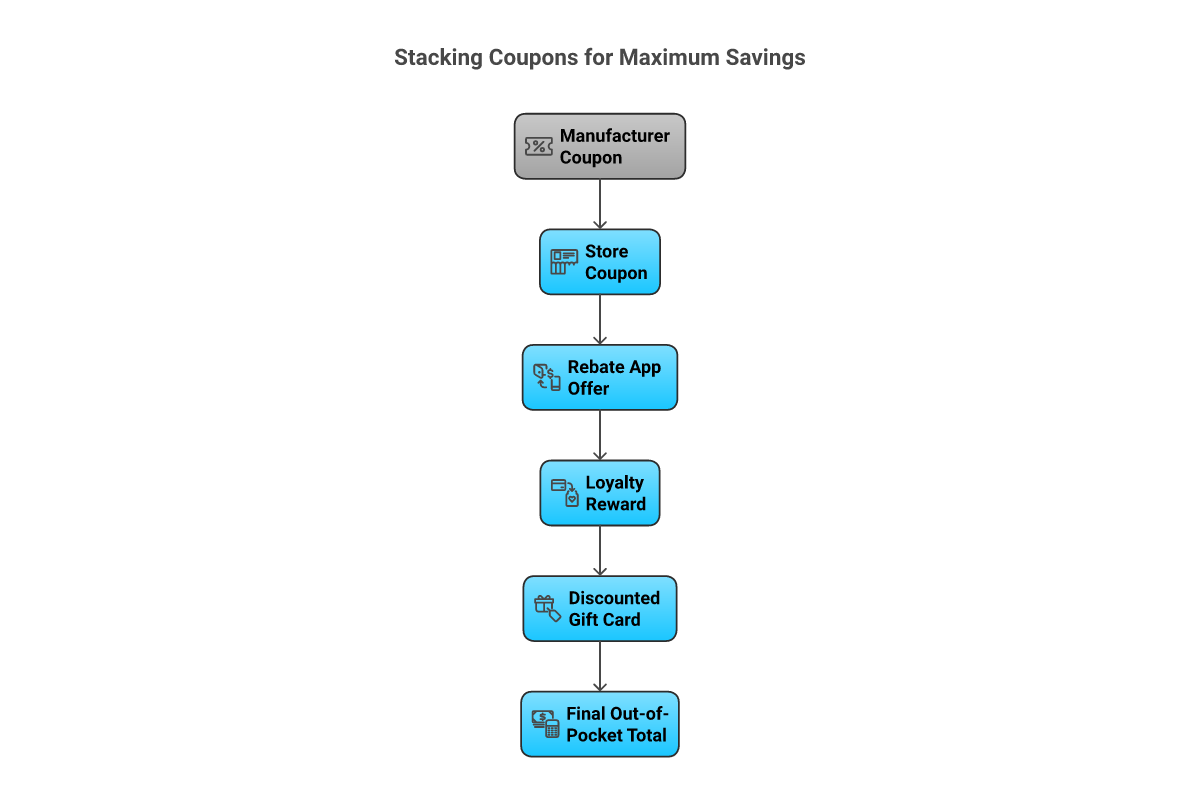
The classic in-store stack runs five levels deep: sale price + manufacturer coupon + store coupon + rebate app offer + loyalty program rewards. Some shoppers add a sixth layer, paying with a discounted gift card purchased below face value. That’s the full stack, and each level is covered below.
Types of Coupons You Can Stack
Understanding what each coupon type is makes the stacking rules click into place.
Manufacturer coupons come from the product brand, not the store. They’re redeemable at any retailer carrying the product. Clip them from a newspaper, print from a coupon site, or load them digitally. Because the brand issues them, stores get reimbursed for accepting them. That’s why the standard rule is one manufacturer coupon per item: the brand covers the discount.
Store coupons come from the retailer itself. CVS ExtraCare coupons, Target Circle deals, and Kroger digital coupons are all store coupons. They only work at that specific chain, and the store absorbs the cost. The stacking magic is that most stores allow one store coupon and one manufacturer coupon on the same item at the same time.
Digital coupons now dominate, with 89% of coupon users preferring them over paper. Many stores let you stack one paper coupon with one digital coupon, which effectively doubles your coupon count on a single item. Worth confirming your store’s policy before assuming it’s one format or the other.
Promo codes are the online version of store coupons: alphanumeric strings entered at checkout. Some retailers allow multiple codes per order (Kohl’s and JCPenney are the main examples). Most limit you to one. Knowing which stores break that rule is where online stackers find their biggest wins.
Rebate app offers are a separate layer entirely. These apps let you scan a receipt and earn cash back no matter what coupons you already used. The store has no visibility into your rebate apps. That’s why they stack on top of any coupon combination.
Loyalty program rewards close out the stack. Target Circle’s 5% card discount, CVS ExtraBucks, and Walgreens myWalgreens cash back all apply after coupons in most cases. They calculate on the already-discounted price.
89%
Prefer digital coupons
93%
Americans use coupons
$2-4K
Grocery savings per year
How to Stack Coupons Step by Step
The full coupon stack has six layers. You don’t need all six on every trip. But knowing each one means you’ll always grab what’s available.
Level 1: Start with a sale price. The best stacks begin on already-discounted items. Check the weekly flyer before making your list. Clearance markdowns, buy-one-get-one sales, and seasonal rollbacks all qualify. A 30% off sale is a massive head start before any coupon even enters the picture.
Level 2: Apply a manufacturer coupon. Match a coupon to your sale item. Brand websites, newspaper inserts, and app-loaded digital coupons all count as manufacturer coupons. The goal is finding coupons on items already on sale, not just on whatever happens to be coupon-eligible.
Level 3: Layer a store coupon on top. Load the store’s own digital coupons to your account before you shop. At CVS, they load to your ExtraCare card. At Target, they appear in Target Circle. At Kroger, they stack in the Kroger app. If you wait until you’re in the store to look, you’ll miss deals that required advance activation.
Level 4: Activate rebate app offers before checkout. Open your rebate apps before leaving home and confirm any offers that apply to your planned purchases. Offer-based apps can require pre-activation. Waiting until after you’ve paid can disqualify you from the rebate even if you have the receipt.
Level 5: Earn loyalty rewards at the register. Scan your loyalty card at checkout. Target Circle Card members get 5% back on every purchase. CVS ExtraBucks print on receipts and work like cash on the next visit. Walgreens myWalgreens cash rewards reduce what a future trip costs. These aren’t instant discounts, but they lower the running cost of staying stocked.
Bonus Level 6: Pay with a discounted gift card. This one surprises people because it seems too simple. Third-party retailers sell gift cards below face value, often at 5-10% off. A $100 gift card bought for $90 means a guaranteed 10% discount on every purchase, applied before any coupon.
Here’s what all six layers look like on one item. Say a bottle of shampoo retails at $10.
| Layer | Action | Price After |
|---|---|---|
| Retail price | None | $10.00 |
| Level 1: Sale | 30% off weekly special | $7.00 |
| Level 2: Manufacturer coupon | $1.50 off brand coupon | $5.50 |
| Level 3: Store coupon | $1.00 ExtraCare digital | $4.50 |
| Level 4: Rebate app | $1.50 rebate on receipt | $3.00 effective |
| Level 5: ExtraBucks earned | $1.00 earned for next trip | $2.00 effective |
| Level 6: Discounted gift card | Paid with 10% off gift card | ~$1.80 effective |
From $10 to under $2, using only discounts stores fully expect some customers to combine. That’s the stack.
💡
Tip: Load your store app coupons the night before a shopping trip. Some digital coupons have daily clip limits that reset at midnight, so clipping early gives you the widest selection.
Best Stores for Coupon Stacking in 2026
Not every retailer makes stacking easy. Policies vary widely, and grocery chains have been getting stricter with stacking in 2025-2026 to protect margins. Here’s the current state at the stores that matter most.
| Store | Manufacturer Coupon | Store Coupon | Digital Coupon | Loyalty Program | Max Layers |
|---|---|---|---|---|---|
| CVS | Yes | Yes (ExtraCare) | Yes | ExtraBucks | 4-5 |
| Target | Yes | Yes (Circle) | Yes | Circle Card 5% | 4-5 |
| Walgreens | Yes | Yes | Yes | myWalgreens cash | 4-5 |
| Kohl’s | Yes | Yes | Yes | Kohl’s Cash | 4 online |
| Kroger | Yes | Yes (digital) | Yes | Fuel points | 3-4 |
| Dollar General | Yes | Yes | Yes | DG Cash | 3 |
| BJ’s Wholesale | Yes | Yes | Yes | BJ’s Perks | 3 |
CVS is the gold standard for in-store stacking. You can combine a manufacturer coupon, a CVS store coupon, ExtraCare card discounts, ExtraBucks, and rebate apps, all on the same items. That’s four or five legitimate savings layers before factoring in a discounted gift card. CVS even lets you stack up to four types of discounts on one transaction: manufacturer coupon, store coupon, ExtraBucks, and rebate app.
Target runs a similarly generous system. Target Circle delivers personalized percentage-off offers that stack with manufacturer coupons. Circle Card members get an automatic 5% back on every purchase, which applies on top of coupon discounts. Pair that with a manufacturer coupon and a Circle offer on the same item and you’re pulling three layers without any special strategy.
Kohl’s is the best online stacking story. A percentage-off code, a dollar-off code, Kohl’s Cash, and a free-shipping code can all apply in a single order. Simultaneously. That’s rare. Most online retailers cap promo codes at one.
Walgreens stacks manufacturer coupons, Walgreens store coupons, myWalgreens rewards, and rebate app offers together. The digital coupon system through the app makes coordination cleaner than the old paper-clipping process.
Kroger eased its digital-paper stacking policy in 2025 after customer pushback. The store still limits identical coupons on a single item, though. One digital plus one paper coupon per item is the general rule. Fuel reward points stack silently on top.
One trend worth tracking: grocery chains are getting stricter with stacking to protect margins. Policies that worked a year ago may have changed. Check each store’s current coupon terms before planning a major stack.
⚠️
Attention: Store coupon policies can change without notice. Check the retailer’s app or help page for the current policy before building a big stack.
Online Coupon Stacking: How to Combine Promo Codes and Cashback
Online stacking uses a different set of layers than in-store shopping. The tools are different, but the principle is the same: find every legitimate discount available and apply them together.
The standard online stack has three tiers. First, enter a promo code at checkout. Second, shop through a cashback portal that tracks your purchase and pays you a percentage back. Third, pay with a rewards credit card to earn points or cash back on the full amount. That’s a clean triple layer without any coupon clipping.
The variable part is finding a working promo code. Manually searching before every checkout is time-consuming, and codes found through random searches have a high failure rate. A browser extension that automatically tests available codes at checkout removes the search step. The DontPayFull browser extension handles this automatically. It tests codes in the background and applies the best one. No copy-pasting needed.
What most guides miss is that promo codes and cashback portals run on completely independent systems. The portal doesn’t know what promo code you entered. The retailer pays the portal a commission for the sale, regardless of any coupon you used. So a 20% off code, 5% cashback through a portal, and 2% back from a rewards card all work simultaneously. All three, on the same order.
There’s one exception worth flagging. Some retailer-specific cashback programs void eligibility if you use certain promo codes, particularly codes that weren’t intended for public distribution. Check the portal’s terms for the specific store before assuming the cashback and promo code will work together.
For stores that allow multiple promo codes, order of entry matters. Enter the higher-value code first. The second code often calculates against the already-reduced price. Entry sequence changes the final number. Kohl’s, in particular, is worth testing with multiple codes before you finalize any large order.
Rebate Apps That Supercharge Your Stack
Rebate apps are the easiest layer to add because they work independently of whatever coupons you’ve already applied. The store has no idea you’re even using them.
Fetch Rewards processes 11 million receipts per day. You upload any grocery or retail receipt and earn points toward gift cards, regardless of which store you visited or what coupons you used. It’s the most passive layer in the entire stack. You’re getting a receipt anyway; you just have to photograph it.
Offer-based apps work differently. They show you specific deals on specific products before you shop. You activate the offer, buy the product, upload proof, and receive cash back. Average savers earn around $261 per year through this type of app on grocery and retail purchases. The tradeoff is planning: you need to check available offers before your shopping list is final, not after.
A practical three-app setup that most dedicated stackers settle on:
- An offer-based app for main rebates on planned purchases
- Fetch Rewards as a passive layer on every receipt
- Checkout 51 as a secondary offer source for items the primary app doesn’t cover
Running multiple rebate apps on the same receipt causes no conflict. You’re submitting the same receipt to apps with different offer inventories. Each app pays on what it has. No coordination between them, no double-dipping issue.
One caveat: some individual offers, not app-wide policy, restrict stacking with coupons. The restriction shows up in the fine print of that specific offer, not the general terms. Check the individual offer before combining it with a coupon on the same item.
Tracking deals across hundreds of stores, one pattern keeps showing up: shoppers who check rebate apps after making their shopping list miss the most valuable offers. The best rebate deals are time-limited and tied to specific quantities. Many expire before casual users even notice. Reviewing your apps before writing the list, rather than scanning receipts afterward, turns rebates from an occasional bonus into a reliable savings layer.
Seasonal Stacking Calendar: When Savings Run Deepest
Coupon availability, rebate app inventory, and retailer promotions all peak at predictable points in the year. Knowing the calendar means you show up when the stack runs deepest.
January is underrated by most stackers. Post-holiday clearance on winter items can hit 50-75% off, and manufacturers push new-year coupons to clear old inventory. Leftover gift cards from the holiday season are still circulating, ready to add the payment layer on already-discounted products.
March and April bring spring cleaning promotions, Easter deals, and a fresh wave of seasonal manufacturer coupons. Tax refund timing overlaps with promotions built around refund spending. Strong window for bigger household purchases.
Memorial Day through the Fourth of July is peak season for outdoor, home improvement, and summer product stacking. Manufacturer coupons on seasonal lines arrive with the promotions. Mid-year clearance on spring inventory often triggers additional rebate app promotions on the same items.
October and November are obvious months, but the specific timing matters. The best stacking windows don’t land on Black Friday itself. Email subscribers get early access codes two weeks before the event. Those codes layer with active sale prices before the general public even sees the deals. Target Circle Deal Days and Kohl’s Credit Events in October allow the full stack. Less competition, too.
December closes the year with holiday sales and gift card promotions. Target regularly runs events where buying gift cards earns bonus gift cards, making the payment layer particularly powerful when purchased during a promotion and spent after it ends.
From what we’ve tracked across major shopping holidays, coupon code availability on DontPayFull peaks in the two weeks before big events, not on the event day itself. By the time Black Friday or Cyber Monday arrive, many of the strongest codes have already been released and sometimes already pulled. Shopping a few days before the peak often gets you the same discounts with none of the checkout congestion.
Coupon Stacking Mistakes That Cost You Money
Most stacking failures come down to a handful of predictable errors. Avoiding them is worth more than finding a new coupon source.
Using two manufacturer coupons on one item. This is the single most common violation, and registers are set up to catch it. Manufacturer coupons have a one-per-item rule because brands won’t reimburse stores twice on the same product. The fix: pair one manufacturer coupon with one store coupon, not two from the same source.
Expired coupons. Digital coupons loaded to a store app typically have a two-week window. Paper inserts run about a month. Clip-and-forget habits result in coupons the system won’t honor at checkout. Check expiration dates when you clip, not while you’re loading the belt.
Skipping the BOGO fine print. Buy-one-get-one deals have some of the most variable stacking rules in retail. Some stores allow manufacturer coupons on both items in a BOGO. Others only allow a coupon on the paid one. A few block coupons entirely during BOGO events. Check the specific promotion.
Buying things you don’t need because the stack looks good. A $3 item you’ll never use isn’t a win just because the stack brought it down from $8. The math only works in your favor when you’re buying products you’d have purchased anyway.
Forgetting to activate digital coupons before checkout. Most store apps require you to explicitly clip or add a digital coupon before it applies at the register. The coupon won’t scan automatically if you didn’t activate it first. A quick app check before leaving the house prevents this.
Using photocopied or screenshot coupons. Every manufacturer coupon carries a unique barcode that’s valid once. Duplicated coupons are rejected or flagged as fraud. This isn’t a gray area and it’s not worth the risk.
Stacking Moves That Work
- + One manufacturer coupon + one store coupon per item
- + Rebate app offers stacked on top of in-store coupons
- + Loyalty rewards earned after coupons apply
- + Discounted gift cards as your payment layer
- + Promo code + cashback portal + rewards card online
Stacking Errors to Avoid
- − Two manufacturer coupons on the same item
- − Expired coupons you forgot to verify
- − Assuming BOGO stacks without reading the fine print
- − Buying unneeded items for the discount thrill
- − Photocopied or screenshot coupons
How to Get Started With Coupon Stacking Today
The barrier to entry is lower than most people assume. You don’t need to overhaul your shopping routine. Start with one store, one stack, and build from there.
Step 1: Pick one store and read its coupon policy. Most major retailers post their policies in the app or website help section. Look for three answers: does it allow manufacturer coupon plus store coupon stacking, does it allow digital plus paper, and how does it treat rebate apps. CVS, Target, and Walgreens all make these policies easy to find.
Step 2: Download the store’s app and two rebate apps. The store app handles digital coupon loading and loyalty card access. The rebate apps run in the background and require almost no attention beyond checking offers before you shop and uploading receipts after.
Step 3: Match your shopping list to current sales before adding coupons. Pull up the weekly ad, write down what’s on sale that you actually need, then go looking for coupons on those specific items. Sale first, coupon second. Coupons on sale items compound. Coupons on full-price items don’t.
Step 4: Start with a two-layer stack. Sale price plus one coupon. Get comfortable with how the app handles digital coupons and how rebate apps accept receipts. Once a two-layer stack feels routine, add the rebate layer. Then loyalty. Then eventually the gift card payment layer.
Step 5: Add a browser extension for automatic online savings. For online orders, an extension that tests codes at checkout handles the promo code layer automatically. DontPayFull maintains a list of the best coupon extensions if you want to compare options. You skip the manual search and don’t have to wonder if you missed a better code somewhere.
The payoff for building this habit is real. Households that stack consistently save $2,000 to $4,000 per year on groceries. No extreme couponing required. That’s before adding online stacking. And the average online purchase already yields a 17.2% discount when promo codes are applied, roughly $30 per checkout. Adding a cashback portal and a rewards card pushes savings higher. No extra effort required.
The Bottom Line
Coupon stacking is legal, widely supported by major retailers, and accessible to any shopper willing to spend a few minutes before each trip. The full stack, sale price plus manufacturer coupon plus store coupon plus rebate app plus loyalty rewards, can cut everyday item prices by 60-80% without anything tricky. Start with one store that allows manufacturer and store coupon stacking (CVS, Target, and Walgreens are the easiest entry points), add one rebate app, and build from there. Consistent stackers save $2,000 to $4,000 per year on groceries alone, and that’s a conservative figure that doesn’t account for online stacking. The strategy doesn’t require expertise. It just requires knowing which discounts are independent of each other and combining all of them.
Frequently Asked Questions
Is coupon stacking legal?
Yes, coupon stacking is completely legal. Stores set their own policies about how many coupons can be applied per item, but using a manufacturer coupon alongside a store coupon is a practice retailers fully anticipate and allow. Coupon fraud is a different matter: using photocopied coupons, lying about a product to redeem a coupon, or using a coupon on items it doesn’t cover. That’s illegal.
What grocery stores allow coupon stacking?
The most stacking-friendly chains are CVS, Walgreens, Kroger, and Dollar General. Target (which includes grocery) and Kohl’s offer strong stacking flexibility in their non-grocery departments. In general, stores with solid loyalty programs and dedicated apps tend to offer more stacking options. That said, grocery chains have been tightening policies in 2025-2026, so always verify a store’s current terms before planning a complex stack.
Can you stack coupon codes online?
It depends on the retailer. Most online stores limit you to one promo code per order. Kohl’s and JCPenney allow multiple codes simultaneously, which is a significant exception worth knowing. But every online retailer, regardless of promo code policy, allows you to combine a promo code with a cashback portal tracking session and a rewards credit card. Those are fully independent systems that don’t interfere with each other.
Is coupon glitching the same as coupon stacking?
No. Coupon stacking means combining multiple legitimate discount types the way stores intend. Coupon glitching exploits technical errors in store systems to apply coupons to products they don’t cover or to transactions that don’t meet the coupon terms. Glitching is considered fraud and can get you banned from the store. Stacking is both legal and encouraged; glitching is neither.
How many coupons can you use on one item?
The standard is one manufacturer coupon plus one store coupon per item. Some stores also allow an additional digital coupon layer on top of that. Rebate app offers are separate and stack independently of coupon counts. A handful of retailers limit you to one coupon total per item, so checking your specific store’s policy before a trip prevents rejected coupons at the register.
Sources
- Capital One Shopping Research 2026: Coupon usage statistics including percentage of Americans using coupons, digital coupon adoption, average online discount value, and household annual savings estimates (2026)
- Savings.com Digital Coupon Usage Statistics: Data on rebate app adoption rates and pre-purchase coupon search behavior (2025)
- Fetch Rewards momentum report via PR Newswire: Daily receipt processing volume for Fetch Rewards (2025)
- Ibotta corporate site: Average annual savings per user and registered user scale
- The Krazy Coupon Lady – Stacking Guide: CVS and Kohl’s stacking policy details, coupon type explanations
- MENAFN 2026 – Grocery Chains Reducing Stacking: Industry report on retailers tightening coupon stacking policies in 2025-2026
Do You Have Any Suggestions?
We're always looking for ways to enrich our content on DontPayFull.com. If you have a valuable resource or other suggestion that could enhance our existing content, we would love to hear from you.
Was this content helpful to you?
Related Articles