No votes yet.
Coupon Usage Statistics 2026: How Americans Save with Coupons
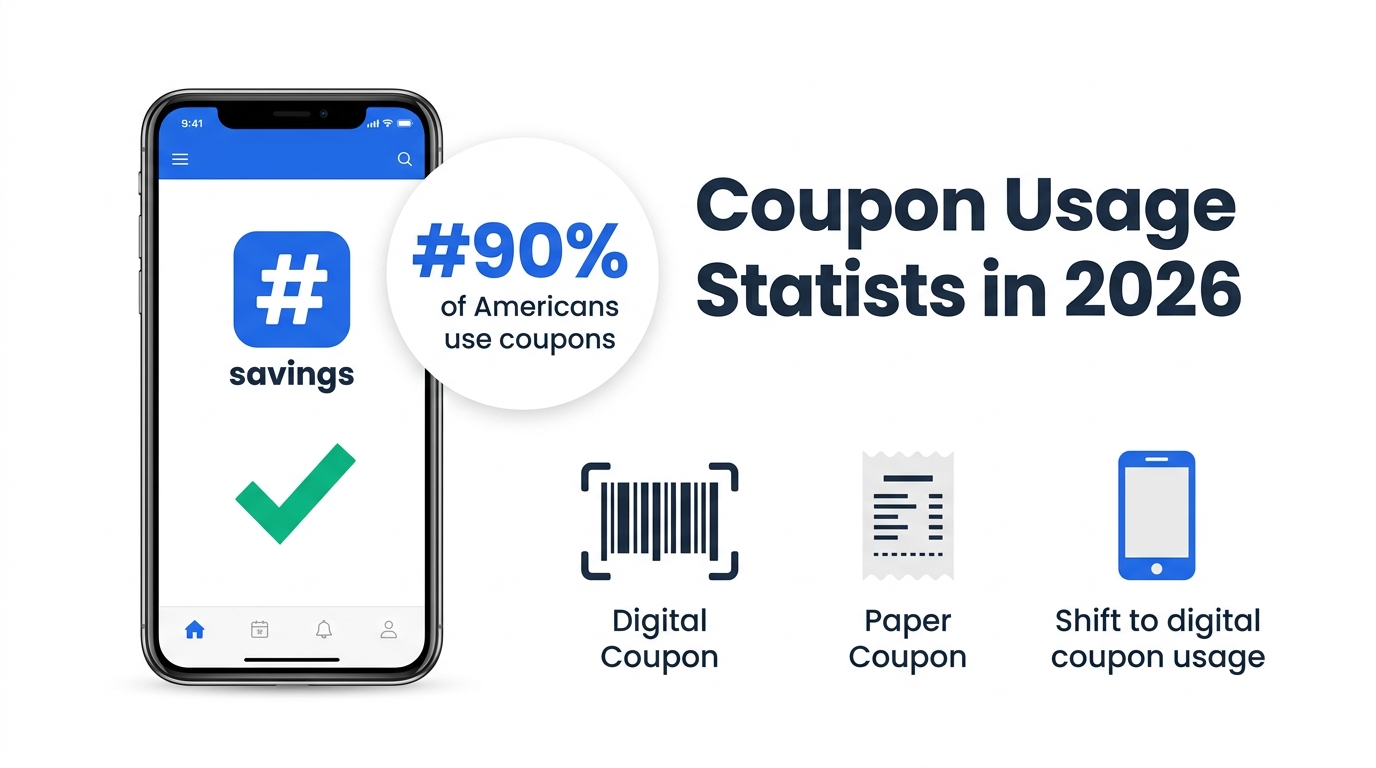
Coupon usage in the US has gone mainstream, with nearly 90% of consumers using coupons and digital redemptions surpassing paper in 2024. This article covers the latest 2026 statistics on how Americans find, use, and save with coupons across all demographics.
After two years of stubborn prices across the US, shoppers didn’t just cut back on spending. Many doubled down on couponing. Inflation pushed consumers back toward habits that had softened during the easy-money years: checking for codes before checkout, downloading loyalty apps, and using browser extensions that apply discounts automatically. The numbers tell a clear story: 62% of Americans now search for promo codes before completing an online purchase, total coupon redemptions hit 871 million in 2024, and the global digital coupon market is currently valued at $6.6 billion. Coupons aren’t a niche habit anymore. They’re mainstream, inflation-fueled, and increasingly mobile.
Below is the most current picture of how Americans are using coupons in 2026.
Key Takeaways
- ✓ Nearly 90% of US consumers have used a coupon, and 78% actively seek one before every shopping trip.
- ✓ Digital formats now account for 53.4% of all redemptions, with 93.5% of digital coupon users redeeming on smartphones.
- ✓ Inflation is the primary driver: 61% of shoppers now use coupons specifically to fight rising prices.
- ✓ The kicker: consumers who use coupons actually spend 18% more on average than shoppers who don’t.
- ✓ The global digital coupon market is projected to reach $7.55 billion by end of 2026, growing at 18.33% annually through 2032.
Key Coupon Statistics at a Glance (2026)
A few headline numbers before we go deeper. The overall story: coupon adoption is near-universal, digital has overtaken paper, and the smartphone is the dominant delivery method.
~90%
US consumers use coupons
169.2M
Digital users in 2025
7-10%
Digital redemption rate
93.5%
Redeem via smartphone
In 2024, total coupon redemptions hit 871 million, with digital accounting for 465.5 million, up nearly 11% in a year, according to Inmar Intelligence. Today, the global digital coupon market is worth about $6.6 billion, and Business Research Insights expects it to clear $7.55 billion by 2027. US digital users numbered 165.5 million in 2024 and climbed to an estimated 169.2 million in 2025. That’s more Americans using digital coupons than the entire population of Germany.
How Many Americans Use Coupons?
Short answer: most of them. 78% of US consumers actively seek out a coupon before each shopping trip, with 45% doing it every single week. That’s not occasional deal-hunting; that’s a routine.
The broader adoption figure sits close to 90%, per eMarketer data. Near-universal usage makes coupons one of the most widely adopted consumer behaviors in the country, ahead of many habits people assume are more common. This behavior spans all demographics, not just budget-conscious households.
Grocery leads by category. More than 93% of US grocery shoppers used a coupon in 2025. The frequency is rising too: the share of grocery shoppers couponing more often than two years ago jumped from 26% in 2023 to 33% in 2025. That timeline tracks almost exactly with the inflation cycle. Not coincidental.
Online shopping layered its own coupon ritual on top of in-store behavior. Before clicking “place order,” 62% of US online shoppers check for a code first. This happens even when no specific deal is advertised. Checking for a discount has become part of the checkout process, and most shoppers feel like they’d be leaving money on the table if they skipped it.
🤔
Did You Know: 850 million coupons were redeemed across all US formats in 2023, a 10% jump from 2022. The 2024 total of 871 million pushed that record higher still.
Digital vs. Paper Coupons: The Shift in How Americans Clip
Digital coupons crossed a meaningful threshold recently. They now account for 53.4% of all US coupon redemptions, with paper at 40.8%, based on Vericast tracking data. The crossover happened around 2024, and the gap continues to widen.
But here’s the thing: volume share isn’t the most interesting data point in this comparison. The redemption rate gap is. Digital coupons redeem at 7-10%, while paper free-standing inserts, the type dropped in Sunday newspapers, hover between 0.5-1%. That’s a roughly 10x efficiency difference on the same dollar of promotional spend. For brands and retailers, that math is hard to argue with.
US Coupon Redemptions by Format (2024-2025)
Digital53.4%
Paper / FSI40.8%
Other formats5.8%
Does this mean paper is dead? Not quite. The 40.8% redemption share tells you a large and loyal segment still uses print, often older shoppers who built the coupon habit before smartphones existed. Paper coupon distribution remains high, but the gap between what’s distributed and what’s actually redeemed keeps growing. More paper goes out, less comes back.
One more useful data point: digital coupons deliver fast. 65% of them are redeemed the same day they’re received, per Gitnux data. Paper coupons typically sit in a drawer or on a fridge for days or weeks first.
Mobile Coupon Statistics: Smartphones Dominate
Most digital coupon activity runs through a phone. 93.5% of US digital coupon users redeemed via mobile in 2025, up from 85.5% in 2020. That five-year climb represents a full generational shift in how Americans access discounts.
35%
of shoppers search for and apply coupons on their phone while standing in the store aisle, not just at home before they leave.
The in-store mobile behavior is telling. That 35% figure from eMarketer captures what happens when a shopper reaches for their phone while deciding between two products on a shelf. They’re checking for an app discount, a store loyalty code, or a manufacturer offer before putting the item in the cart. Grocery chains and big-box retailers anticipated this shift and built their loyalty apps around it. The behavior stuck.
Browser extensions are the desktop-side parallel. 48% of US consumers now use browser tools that automatically test coupon codes when they check out online. That adoption number barely registered five years ago. The behavior is simple: install once, get automatic savings on every future purchase. DontPayFull’s browser extension works this way, testing available codes at checkout so you don’t have to dig through search results manually.
Who Uses Coupons Most: A Demographic Breakdown
Coupon use is close to universal across US demographics. But patterns differ meaningfully by age and generation, affecting which channels work best.
Coupon Usage by Generation
Here’s the counterintuitive part: older Americans use coupons the most. 87% of Americans aged 18-34 use coupons, rising to 91% for ages 35-54, and 96% for those 55+. Baby Boomers are the most consistent users by frequency, though they lean toward paper compared to younger cohorts.
Coupon Usage Rate by Age Group
Share of US consumers who use coupons, by age bracket (SpendMeNot, 2025)
Ages 18-34
87%
87%
Ages 35-54
91%
91%
Ages 55+
96%
96%
Millennials occupy an interesting position. They represent 42% of all US coupon users by volume and use digital coupons three times more often than Boomers, per Gitnux data. Also, 89% of Millennials say they’d try a new brand if offered a coupon, the highest brand-switching rate of any generation.
Gen Z’s couponing behavior differs in where they discover deals. 55% of Gen Z consumers find coupons through social media, compared to just 22% via email. That’s the inverse of how older cohorts access discounts.
Coupon Usage by Gender and Income
Women account for 68% of primary coupon clippers in US households and save an average of $1,200 per year through coupon use, per Gitnux. Households with a committed coupon user tend to be more systematic about purchase timing and category substitution.
Low-income households (under $30,000 per year) use coupons 2.5 times more frequently than higher-income households. But higher-income shoppers aren’t absent; they just concentrate coupon use on bigger categories like electronics and travel rather than routine grocery runs.
Households with children under 18 use coupons 37% more often than non-parent households. Parents buying diapers, food, and school supplies at high frequency are a natural coupon-heavy segment. The economics make it obvious.
Inflation and the Coupon Comeback
The clearest signal in the 2025-2026 coupon data is the inflation connection. 61% of US shoppers now say they use coupons specifically to offset rising prices. That’s not the same as just “finding deals”; it’s a deliberate response to economic pressure.
Grocery numbers confirm the shift. The share of shoppers couponing more frequently jumped from 26% in 2023 to 33% in 2025. A 7-point move in two years matches exactly the period when food prices stayed elevated after the initial spike.
We see this pattern constantly on our own platform. Search volume for coupon codes spikes whenever a major price increase cycle hits a category. It happened with grocery in 2022-2023, with home goods after supply chain disruptions, and with apparel as import costs climbed. The behavior echoes what happened during 2008-2009: economic pressure turns casual coupon users into committed ones, and most of them don’t go back.
Inmar Intelligence reports that 95% of US consumers now say coupons and discounts are critical for managing seasonal and holiday budgets. That’s not a niche sentiment. It’s nearly unanimous. Brands that treat coupons purely as a margin cost are missing the loyalty signal in that number.
How Americans Find Coupons in 2026
Search is still the dominant starting point. 59% of US shoppers head to a search engine to look for a code before completing a purchase. But several others are close behind.
How Americans Discover Coupons
Share of US shoppers using each discovery channel (eMarketer / Gitnux, 2026)
Search engines
59%
59%
Browser extensions
48%
48%
Brand / retailer emails
47%
47%
Coupon websites
46%
46%
Store apps / websites
41%
41%
Social media
34%
34%
That 48% figure for browser extensions is a big deal. Nearly half of US consumers now have a tool running in the background that tests codes at checkout automatically. More Americans use auto-coupon extensions than read retailer email newsletters.
From our perspective, pairing a search with a dedicated aggregator works better than using just one or the other. When you land on a verified site like DontPayFull, you get codes that have actually been tested. Expired codes at checkout are still one of the most common reasons shoppers abandon a cart.
Social media sits at 34% overall, but that masks a generational split. For Gen Z it’s the primary discovery channel at 55%. Email, which leads for Boomers and Gen X, lands at just 22% for that cohort.
What Types of Coupons Do Americans Prefer?
Shoppers clearly prefer percentage-off deals. About 67% of people go for them, while 61% prefer BOGO offers, per eMarketer. Straight dollar-off coupons actually trail both, even though they’re still everywhere in grocery circulars.
Here’s something most coupon guides don’t mention: percentage-off codes tend to have higher working-code rates than fixed-dollar codes. From processing millions of codes across our platform, we’ve seen that stores update percentage-off codes more frequently because they’re tied directly to sale pricing systems rather than issued manually in batches. A fixed $10 off code can expire and keep circulating for weeks without getting flagged. A 20% off code tends to have a tighter, more defined validity window. That’s useful to know when you’re deciding which code to try first at checkout.
Category preferences align with daily spending patterns. Grocery coupons are the priority for 62% of shoppers, with apparel next at 28%. And speed of redemption matters: 65% of digital coupons are used the same day they’re received, per Gitnux data. Most shoppers don’t stockpile deals. They use them immediately or not at all.
Free shipping offers function like coupons even when they’re not labeled as such. A threshold-based free shipping deal often drives more cart additions than a percentage-off code, particularly for orders where shipping cost exceeds the value of a typical discount.
How Coupons Change Shopping Behavior
The finding that surprises people most: coupon users spend more, not less. Consumers who use coupons spend 18% more on average than shoppers who don’t, per eMarketer. Why would a discount increase total spending? A 20% off code turns a “maybe later” item into an immediate add-to-cart. A free shipping offer prompts three extra items to hit the threshold. The discount creates permission to spend.
Unplanned purchases are a direct result of coupon availability. 67% of US shoppers report making an unplanned purchase specifically because they found a coupon or discount, eMarketer data shows. This is exactly why retailers issue coupons even on categories they don’t technically need to discount: the traffic and basket-size effects outweigh the margin cost. The math works in the retailer’s favor.
Brand switching is another coupon-driven behavior that gets underestimated. 89% of Millennials say they’d try a new brand if offered a coupon. Numbers across other generations are similar: 86% of Gen X, 78% of Gen Z, 76% of Baby Boomers. Coupons lower the perceived risk of trying something unfamiliar. That makes them one of the most cost-effective brand introduction tools in consumer marketing, not just a way to move existing inventory.
The flip side shows up at checkout. When a shopper expects a code and can’t find one, they often leave the cart behind. 49% of consumers report abandoning online carts when no coupon is available, per Gitnux. For a large share of shoppers, expecting a discount at checkout is just normal now.
💡
Tip: Before abandoning a cart because you can’t find a code, search the store name on DontPayFull. Working codes often surface in under a minute, and the search is free.
The Digital Coupon Market: Size and Growth Projections
The global digital coupon market hit $6.6 billion in 2025 and is on track to reach $7.55 billion by end of 2026, per Business Research Insights. That’s 10%+ growth in a single year, and it’s not the ceiling. The market is forecast to compound at 18.33% annually through 2032, when it would reach $27.43 billion.
A few forces are driving that trajectory. Smartphone adoption among digital coupon users is near-universal and still climbing. E-commerce continues expanding its share of total retail, and each incremental online purchase creates another opportunity for a code to be applied. AI-powered personalization is also changing distribution. Brands are moving from mass-send batches to targeted codes tied to individual purchase history.
The US market specifically is projected to grow from around $6.7 billion in 2024 toward $11 billion by 2032. Over 45,000 US retail stores had integrated digital coupons with their loyalty programs as of 2023, per the National Retail Federation. That infrastructure explains why digital redemptions are growing faster than total coupon volume.
Digital coupon adoption among US adults grew roughly 35% over the past five years. The floor keeps rising, and there’s still a meaningful segment of older shoppers who haven’t moved fully from paper to digital.
DontPayFull Tips: How to Save More with Coupons in 2026
Here’s the practical side.
What most guides miss is that coupon success isn’t about finding more codes. It’s about finding codes that actually work. The expired-code problem is significant: many code lists online are never verified for accuracy, which is why the “search Google and paste” method fails far more often than it should. Tracking deal performance across thousands of stores, we verify codes before they appear on DontPayFull. That’s the difference between a 7-10% redemption rate and the failure rates you see on unverified lists, which can reach 60-80% for codes posted without testing.
Stack when the store allows it. Some retailers let you combine a promo code with a store loyalty discount and a sale price. Kohl’s is the classic example, where a store card discount can stack on top of a percentage-off code. Target occasionally allows manufacturer coupons to combine with store promotions. Savings compound when you hit the right combination.
Browser extension plus a coupon search equals the 3-minute savings stack. Set up an auto-coupon extension for routine checkouts and do a manual search on planned purchases above a certain dollar threshold. The extension handles smaller everyday saves. The manual search catches the bigger ones where it actually moves the needle.
Timing by category matters more than most shoppers realize. Based on seasonal patterns we track, grocery coupon availability peaks in January and early September. Electronics codes are most plentiful in November and early January. Apparel codes cluster in July and late January, when clearance season overlaps with new collection launches.
For verified codes across thousands of US stores, browse the DontPayFull coupon database and search by store or category before your next purchase.
The Bottom Line
Coupon use in the US has never been more mainstream or more mobile. Nearly 90% of Americans use coupons, 78% actively seek them before each shopping trip, and 93.5% of digital coupon activity now runs through a smartphone. Inflation accelerated adoption in 2023-2025, pushing 33% of grocery shoppers to coupon more frequently than before. For individual shoppers: use verified codes from a trusted source. Stack with loyalty discounts where the store allows it. Let a browser extension handle routine checkouts automatically. The average engaged coupon user saves meaningfully, and the habit doesn’t take much time once the right tools are in place.
Frequently Asked Questions
What percentage of Americans use coupons in 2026?
Nearly 90% of US consumers have used a coupon at some point, with 78% actively seeking one before each shopping trip. Figures vary across studies because surveys define “coupon use” differently, ranging from “ever used” to “uses regularly.” The 45% who use coupons weekly represent the most committed segment.
How much do Americans save with coupons each year?
Savings vary significantly by household and category focus. Women who are primary coupon clippers save an average of $1,200 per year, per Gitnux research. Grocery coupons deliver consistent but modest per-trip savings. Electronics and apparel coupons can yield larger one-time discounts, especially around seasonal clearance events.
Are digital coupons more effective than paper coupons?
Yes, by a significant margin. Digital coupons redeem at 7-10% compared to 0.5-1% for paper free-standing inserts, roughly a 10x difference. Digital also delivers faster: 65% of digital coupons are redeemed the same day they’re received, versus days or weeks for paper.
What generation uses coupons the most?
Baby Boomers (55+) have the highest overall usage rate at 96%. But Millennials (ages 25-40) represent 42% of all US coupon users by volume and use digital coupons three times more frequently than Boomers. The generations differ in usage rate versus digital intensity.
Are coupons more popular because of inflation?
Yes. 61% of US shoppers now explicitly say they use coupons to offset inflation, and the share of grocery shoppers couponing more frequently rose from 26% in 2023 to 33% in 2025. The timing aligns almost exactly with the sustained inflation cycle of 2022-2025.
What is the most popular type of coupon among Americans?
Percentage-off coupons top the list at 67%, followed by buy-one-get-one deals at 61%, per eMarketer. Dollar-off formats are common but rank lower in consumer preference, particularly as average order values have risen with inflation.
How many Americans use mobile coupons on their smartphones?
An estimated 169.2 million US adults used digital coupons in 2025, and 93.5% of them redeemed via smartphone. By end of 2026, smartphone redemption among digital coupon users is projected to reach 93.8%, per eMarketer/Insider Intelligence.
Methodology and Data Sources
This article aggregates statistics from primary and secondary research published between 2022 and 2026. Sources include eMarketer, Insider Intelligence, Inmar Intelligence, Vericast, Business Research Insights, Gitnux Market Research, SpendMeNot, and the National Retail Federation. Where multiple sources report the same metric with slightly different figures, the most recent available data is used. Some statistics are reported through third-party research aggregators citing original studies. Note on variability: different surveys define “coupon use” differently. That’s why usage rate figures range from 78% to over 90% across sources. Our editorial team reviews statistics regularly for accuracy and recency.
Sources
- DemandSage – Coupon Statistics 2026: Aggregated coupon usage, redemption volume, and market statistics citing eMarketer, Business Research Insights, and others (2025-2026)
2. Gitnux Market Research – Coupon Industry Statistics: Consumer behavior, demographic breakdowns, inflation impact, and browser extension adoption (2026)
3. BloggersPassion – Coupon Statistics: Mobile and smartphone coupon adoption data citing eMarketer and Statista (2025)
4. SpendMeNot – Coupon Statistics: Age-group coupon usage rates and demographic data (2025)
Do You Have Any Suggestions?
We're always looking for ways to enrich our content on DontPayFull.com. If you have a valuable resource or other suggestion that could enhance our existing content, we would love to hear from you.
Was this content helpful to you?
Related Articles