No votes yet.

Middle Class Spending Statistics 2026: Income, Habits, and Trends
Middle class spending statistics for 2026 reveal how 51% of Americans spend their budgets, where the money goes, and how inflation has reshaped household finances. Find income thresholds, savings rates, and debt levels.
Most people assume the American middle class is struggling because it’s spending too much on luxuries. The data tells a very different story.
The middle class isn’t being squeezed by lavish spending. It’s getting squeezed by the basics: housing, insurance, food, and healthcare. For the third consecutive year, spending growth has outpaced income growth for middle-income households, per the Federal Reserve’s SHED 2024 report. And the gap isn’t closing.
Our team tracks deals and pricing data across thousands of stores, which puts us at an interesting vantage point on middle-class consumer behavior. When people are financially squeezed, coupon and deal usage shifts in predictable ways. What we’re seeing right now matches the data below almost exactly.
Key Takeaways
- ✓ The middle class has shrunk from 61% of Americans in 1971 to just 51% in 2023, per Pew Research.
- ✓ Middle-class households (third income quintile) spent an average of $55,900 per year in 2024, with housing alone consuming 33.4% of that budget.
- ✓ For three years in a row, spending growth has outpaced income growth among middle-income Americans, per the Federal Reserve.
- ✓ 98% of middle-class shoppers say retailers could be doing more to meet their needs, and 58% specifically want better prices.
- ✓ Total US household debt hit a record $18.8 trillion at the end of 2025, with credit card balances alone reaching $1.28 trillion.
What Is the Middle Class? Income Thresholds and Definitions
The most widely used definition comes from Pew Research: a “middle-income” household earns between two-thirds and double the national median income for its household size. For a three-person household in 2022, that meant roughly $56,600 to $169,800 annually.
Income Definition Statistics
- The national middle-class income range for a three-person household was approximately $56,600 to $169,800 in 2022, using the Pew Research two-thirds-to-double-median definition.
- US median household income rose steadily from $60,293 in 2018 to $78,538 in 2023, a 30.3% increase over five years, per the US Census Bureau ACS.
- Middle-class income thresholds vary dramatically by metro area, ranging from $45,478 to $135,449 in major cities, per a SmartAsset 2025 analysis of Census data.
- In Youngstown, OH, the middle-class range runs from about $38,454 to $115,716, while in Los Angeles it stretches to $51,561 to $154,459, per Brookings Institution.
- Massachusetts households have the highest middle-class income band nationally ($65,565 to $196,716), while the Detroit metro sits near the bottom.
- Researchers debate whether income, wealth, or consumption measures best define the middle class. Income definitions dominate policy discussions; consumption-based measures tend to show a healthier picture.
That $56,600 to $169,800 range covers a lot of ground. A family in Jackson, Tennessee and a family in San Francisco can both qualify as “middle class” by national thresholds while living totally different financial lives. Geographic variation matters a lot here.
The SmartAsset analysis of 2023 Census data found that middle-class income in big cities ranges from $45,478 to $135,449, depending on where you live. And that’s just in major metros. Rural areas and smaller cities shift the picture again.
US median household income grew steadily from $60,293 in 2018 to $78,538 in 2023 (Census Bureau ACS via Data Commons). That looks good on paper. But cumulative inflation ran well above 20% over that same stretch, so real gains were much smaller than the headline numbers show.
Here’s what most income guides miss: the definition debate isn’t just academic. Whether you use income, wealth, or consumption to define the middle class changes who counts as “squeezed” and who counts as stable. Policy researchers at Brookings found that at least 20% of middle-class households still can’t afford basics in any of 160 metro areas they studied.
Middle-Class Income Range by Metro (Annual, 3-Person Household)
Upper bound of local middle-class range, selected metros. Source: Brookings/SmartAsset, 2025
Los Angeles, CA$154,459
Boston, MA$119,500
Chicago, IL$98,900
Dallas, TX$91,200
Youngstown, OH$75,716
How Many Americans Are Middle Class?
Just over half of US adults, about 51%, lived in middle-income households in 2023. That’s down from 61% in 1971, a 10-percentage-point decline over five decades, per Pew Research.
Middle Class Population Statistics
- In 1971, 61% of Americans lived in middle-class households. By 2023, that share had dropped to 51%, a loss of 10 percentage points over 52 years (Pew Research).
- As of 2022, roughly 52% of US adults were in middle-income households, while 28% were lower-income and 19% were upper-income, per Pew Research.
- The share of Americans in middle-income households varies by metro area, from 42% in San Jose, CA to 66% in Olympia-Lacey-Tumwater, WA.
- Racial breakdowns reveal significant gaps: median middle-class incomes differ substantially by race, with White and Asian households significantly outpacing Black, Latino, and Native American middle-class households (Brookings, 2025).
- One-third of American middle-class families struggle to afford basic necessities as of 2023, per Brookings Institution research across 160 metro areas.
- AEI analysis from 2026 argues the middle class is shrinking partly because more households are moving into the upper-income tier, suggesting the trend reflects economic progress as much as decline.
The 10-point drop from 61% to 51% sounds alarming. But not all of it is bad news. Some households left the middle class by moving up, not down. The upper-income share grew from 14% to 19% since 1971. The lower-income share also grew, from 25% to 28%. The middle is shrinking from both directions at once.
Even within that 51%, financial comfort varies widely. The San Jose metro has just 42% of residents in the middle-income band. Not because people are poor. Because so many moved up into high-income due to tech wages. Olympia, WA is the opposite: 66% middle class with much less income spread.
One figure that doesn’t get enough attention: the racial breakdown. Brookings 2025 research found 27% of White middle-class households can’t afford basics, versus 39% of Black, 41% of Asian, 46% of Native American, and 50% of Latino households in the same income band. Same income. Very different reality.
Middle Class Spending Overview: How Much Does the Average Household Spend?
The average US consumer unit spent $78,535 in 2024, per the Bureau of Labor Statistics Consumer Expenditure Survey. Middle-class households, defined as the third income quintile, came in at around $55,900.
Overall Spending Statistics
- Average annual expenditures for all US consumer units were $72,973 in 2022, $77,158 in 2023, and $78,535 in 2024 (Bureau of Labor Statistics Consumer Expenditure Survey).
- Average income before taxes for all consumer units was $94,003 in 2022, $101,805 in 2023, and $104,207 in 2024, per BLS.
- The third quintile (middle class) averaged approximately $55,900 in annual expenditures in 2024, compared to $131,342 for the highest quintile.
- Middle-class spending grew 15.8% since 2018, trailing high-income households (+18.9%) but outpacing low-income households (+9.1%), per BLS data.
- The middle 40% of US households by income contributed about 34% of total annual consumer spending in 2023, per Bank of America Institute research.
- In real inflation-adjusted terms, middle-income spending grew 13.3% from January 2018 to August 2024, while high-income spending rose 16.7% and low-income spending gained just 7.9%, per Federal Reserve analysis.
The BLS releases its Consumer Expenditure Survey about 12 months after the year ends. The 2024 data cited here came out in December 2025. It’s the freshest annual data available.
Total spending rose 7.6% from 2022 to 2024. But that overall number hides a lot. Housing and insurance drove most of the increase. Discretionary spending barely moved. The gap between what middle-class households earn and what they spend is tighter than it looks.
The Bank of America Institute found the middle 40% drives only 34% of total spending. And the top 10%? They drive more than 45%, per Moody’s Analytics data via the Minneapolis Fed. The middle class isn’t just smaller by headcount. Its economic weight is shrinking too.
Average Annual Expenditures by Income Quintile (2024)
All US consumer units. Source: Bureau of Labor Statistics Consumer Expenditure Survey, 2024
Highest Quintile$131,342
Fourth Quintile$85,900
Middle Quintile$55,900
Second Quintile$38,800
Lowest Quintile$26,046
All consumer units average: $78,535 (2024)
Middle Class Spending by Category: Where the Money Goes
Housing is the dominant expense for middle-class households, consuming roughly 33.4% of the average budget. That’s $18,345 a year out of a roughly $55,900 total, just for shelter.
Spending by Category Statistics
- Housing was the largest spending category for middle-class households, averaging approximately $18,345 (33.4% of budget) in 2024, per BLS Consumer Expenditure Survey.
- Transportation was the second largest category at 17% of spending, with vehicle insurance surging 12.3% in 2024 alone, per BLS CES 2024.
- Food spending averaged about $10,630 for middle-class households in 2024, representing 12.9% of the total budget (BLS). Separately, USDA ERS data puts middle-income quintile food spending at $7,989 in 2023.
- Healthcare consumed roughly $4,285 (7.9%) of middle-class spending in 2024, per BLS. A striking 28% of US adults skipped medical care due to cost in 2024, per the Federal Reserve SHED report.
- Personal insurance and pensions accounted for 12.5% of all consumer unit spending in 2024, making it the second largest category after housing for the total population.
- Meats, poultry, fish, and eggs rose 21.5% in 2024, the sharpest category increase in the BLS Consumer Expenditure Survey that year.
- For comparison: BLS 2018 data showed middle-class households spending Housing 34.5%, Transportation 17%, Food 15.9%, Medical 7.5%, showing food’s budget share has compressed as other costs rose.
Housing, transportation, and food together take up roughly 63% of the middle-class budget. That leaves 37% for everything else: healthcare, education, clothing, savings, all of it. No wonder 28% of adults skipped medical care in 2024. When three budget lines eat two-thirds of your income, cuts have to come from somewhere.
The food figure is worth a second look. BLS data puts middle-class food spending at around $10,630 per year. The USDA Economic Research Service’s most recent data puts it at $7,989 for 2023. The gap likely comes down to how each survey classifies food versus restaurant meals. Both figures exclude alcohol. Either way, middle-class families spend a much smaller share of income on food than lower-income households do. Lower-income families devoted 32.6% of after-tax income to food. Middle-class households spend far less as a percentage.
Middle-Class Spending by Category (2024)
Housing33.4%
Transportation17%
Food12.9%
Ins. & Pensions12.5%
Healthcare7.9%
All Other16.3%
Tracking deal behavior across thousands of stores, we’ve noticed that when transportation costs spike, it typically drives increased interest in auto-related coupons and fuel savings tools. The 12.3% surge in vehicle insurance costs in 2024 showed up clearly in search patterns on our platform. People were hunting for any discount they could find in a category where coupons are actually pretty rare.
Housing Costs and the Middle-Class Affordability Crisis
Housing spending rose 3.3% in 2024, the only statistically significant increase among major BLS spending categories that year. And it’s not just renters feeling the pressure.
Housing Cost Statistics
- Housing expenditures increased 3.3% in 2024, the only statistically significant spending increase among major categories, per BLS Consumer Expenditure Survey.
- Owned dwellings costs rose 7.0% in 2024; rented dwellings rose 5.4%, both outpacing overall inflation.
- An estimated 37.1 million US households are cost-burdened, spending more than 30% of income on housing.
- 33% of middle-income renters were cost-burdened in 2022, up 6.3 percentage points from 2019, per Harvard Joint Center for Housing Studies. That’s roughly 14.4 million middle-income renter households.
- The share of cost-burdened middle-income renters ranges from 55% in Florida to just 6% in North Dakota, per Harvard JCHS analysis.
- At least 20% of the middle class cannot afford to live in any of the 160 metro areas analyzed by Brookings Institution in 2025.
The Harvard Joint Center for Housing Studies defines middle-income renters as those earning 60-120% of area median income. In 2022, 14.4 million renter households fell into that band. One in three was cost-burdened. That’s a substantial jump from 2019, when the figure was closer to one in four.
State variation is extreme. In Florida, 55% of middle-income renters are cost-burdened. Hawaii sits at 50%, Nevada at 49%. Compare that to North Dakota at 6%. Same “middle class” label, wildly different housing reality.
💡
Tip: DontPayFull has coupon pages for major home improvement retailers including Home Depot and Lowe’s. If housing is your largest budget category, recurring savings on maintenance and improvement costs add up quickly over a year.
The Brookings finding that 20% of the middle class can’t afford to live in any analyzed metro is particularly striking. Not “can barely afford” but literally cannot find housing within their budget in any of 160 metro areas. This is the structural housing affordability crisis quantified.
Middle Class Savings Rate and Emergency Fund Statistics
The personal savings rate hit 4.5% as of January 2026, per the Bureau of Economic Analysis. That’s above the near-zero levels of 2022 but well below the pandemic-era highs of 30%+ that briefly made American household balance sheets look unusually healthy.
Savings and Emergency Fund Statistics
- The US personal savings rate was 4.5% as of January 2026, per the Bureau of Economic Analysis, well below pandemic highs but above 2022 lows.
- Nearly 1 in 4 Americans have no emergency savings at all, per Bankrate’s 2025 emergency savings survey.
- 63% of adults said they could cover a hypothetical $400 emergency expense entirely in cash or its equivalent in 2024, per the Federal Reserve SHED report. This figure was unchanged from the prior year.
- 42% of households said they could cover expenses for a month or less if they lost their main source of income, per the CFPB Making Ends Meet survey (2024).
- Higher monthly debt-to-income ratios are associated with a 15% decrease in the likelihood of saving among middle-class households, per Federal Reserve Bank of Chicago research.
- For three consecutive years, spending growth has outpaced income growth among middle-income Americans, per Federal Reserve SHED 2024 data. In 2024, 32% of adults reported higher family income while 37% reported increased spending.
The 63% figure for the $400 emergency test has gotten a lot of attention. But it actually shows improvement from a decade ago, when only about 50% could cover $400 without borrowing. Good news there. The CFPB’s Making Ends Meet survey tells a starker story: 42% of households could cover a month or less of expenses if income stopped. That’s not just an emergency fund gap. It’s a structural problem.
The Chicago Fed research on debt-to-income ratios deserves more attention than it gets. Higher debt payments cut the odds of saving by 15%. Debt crowds out savings. Less savings means more vulnerability to income shocks. More income shocks often mean more debt. It’s a cycle.
So what does “middle class savings” actually look like in practice? For a household earning $75,000 a year and saving at a 4.5% rate, that’s $3,375 annually, or about $281 a month. Spread across 12 months, that’s not much runway if a major expense hits.
4.5%
US savings rate (Jan 2026)
42%
Could cover 1 month or less
1 in 4
Americans have zero savings
Middle Class Debt: Credit Cards, Mortgages, and Financial Stress
Total US household debt reached a record $18.8 trillion at the end of 2025, per the Federal Reserve Bank of New York. Credit card balances alone hit $1.28 trillion, another record.
Household Debt Statistics
- Total US household debt reached a record $18.8 trillion at the end of 2025, per the Federal Reserve Bank of New York.
- Credit card balances hit a record $1.28 trillion at end of 2025, surpassing the previous record of $1.13 trillion set just quarters earlier (NY Fed).
- Mortgage balances stood at $13.17 trillion, making it the largest single component of household debt (NY Fed, Q4 2025).
- 36.4% of Americans experienced significant difficulty paying regular household expenses in April 2024, per LendingTree.
- 17% of adults did not pay all bills in full in 2024, a figure unchanged from 2023, per Federal Reserve SHED 2024.
- Student loan debt continues to suppress saving behavior particularly among younger middle-class households, as loan repayments resumed after the 2023 end of the pandemic pause.
The credit card number deserves unpacking. $1.28 trillion across all households works out to roughly $10,000 per balance-carrying household. At APRs of 20%+, that’s $2,000 or more a year in interest. Just to stay even. For a middle-class family trying to save, that’s real money lost every month.
Mortgage balances at $13.17 trillion tell a split story. People who bought homes before 2020 are sitting on big appreciation. People who bought during or after the surge are carrying debt loads that past generations of middle-class buyers couldn’t have imagined.
What about renters? The Federal Reserve SHED 2024 report found 17% of adults couldn’t pay all bills in full in 2024. Renters are more likely to be in that group, especially middle-income renters in high-cost metros. They don’t have home equity to fall back on.
🤔
Did You Know: Middle-class households increasingly carry more debt than they hold in emergency savings. For a household with $5,000 in savings and $12,000 in credit card debt, the net “savings” position is actually negative $7,000.
The K-Shaped Economy: How Spending Inequality Is Growing
The top 10% of US households now account for more than 45% of all consumer spending. The bottom 60% accounts for just 23%. That’s not a description of economic distress. It’s a description of a fundamentally bifurcated consumer economy.
Spending Inequality Statistics
- The top 10% of US households account for more than 45% of total consumer spending, while the bottom 60% accounts for just 23%, per Moody’s Analytics data.
- Spending by top 10% households grew 62% between Q3 2020 and Q3 2025, compared to near-flat growth for middle-income households in the same period.
- Lower- and middle-income household spending growth ticked down to 0.3% and 1.0% respectively in January 2026, while high-income spending grew at 4%+, per Bank of America Institute Consumer Checkpoint.
- In real terms (Jan 2018 to Aug 2024), spending grew 7.9% for low-income, 13.3% for middle-income, and 16.7% for high-income households, per Federal Reserve analysis.
- The divergence in spending trends has led economists to describe middle-income Americans as beginning to behave more like lower-income consumers in their purchasing caution.
The Minneapolis Fed’s March 2026 analysis is the most current look at this divide. Their review of Moody’s and Bank of America Institute data shows the K-shape has gotten sharper since the pandemic, not flatter. High-income spending powered ahead. Middle- and low-income spending went basically nowhere.
What does “K-shaped” mean in real terms? Think about which retailers are doing well. Luxury brands, high-end travel, premium services. Dollar stores and discount grocers. Both ends are fine. The middle is getting squeezed: mid-tier department stores, full-price specialty retail, any brand that depends on middle-class discretionary spending.
From tracking deal behavior across stores we monitor, we’ve seen the middle tier shift clearly over the past two years. Search volume for grocery coupons, discount codes for everyday items, and cashback deals on essentials has grown faster than for luxury categories. Middle-class consumers are doing what the data predicts: optimizing hard on necessities.
Middle Class Shopping Behavior: Value-Seeking, Loyalty, and Deal Usage
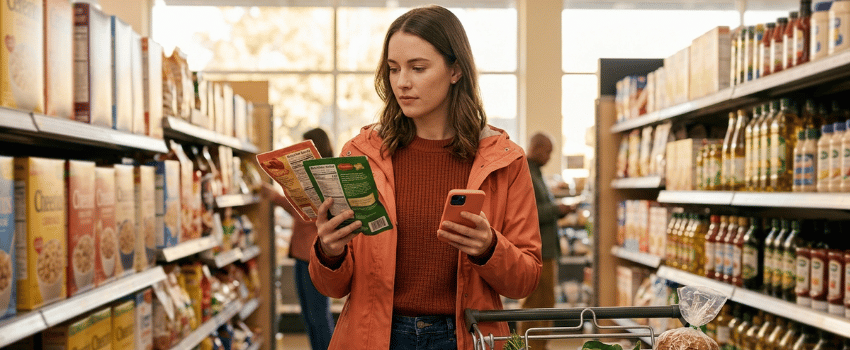
When Bread Financial surveyed middle-class shoppers in 2024, the results were striking. 98% said retailers could be doing more to meet their needs. Not 60%, not 75%. Ninety-eight percent.
Shopping Behavior Statistics
- 98% of middle-class shoppers believe retailers could do more to better meet their needs, per Bread Financial’s 2024 State of the Middle-Class Shopper survey.
- 91% of middle-class shoppers say they’re focused more on needs than wants, and 59% are actively concerned about inflation’s impact on their spending, per Bread Financial 2024.
- 58% of middle-class shoppers want better prices from retailers, while 47% want more sales and promotions, per Bread Financial 2024.
- 64% of middle-class families use comparison apps or price-tracking tools when shopping, per industry analysis.
- 41% shifted part of their grocery budget to discount retailers in 2025, reflecting the broader trade-down trend among middle-income consumers.
- 47% are motivated to purchase from a brand they love when that brand offers improved loyalty rewards, and 37% specifically want better loyalty programs from their preferred retailers, per Bread Financial.
The 91% who say they’re prioritizing needs over wants, combined with the 64% using comparison apps, paints a picture of a deliberately frugal middle class. Not broke, but deliberate. These shoppers are doing the work.
What most guides miss is that the deal-seeking behavior described in the Bread Financial data isn’t new, but the intensity has shifted. We track coupon usage across thousands of stores, and the pattern we keep seeing is that middle-class shoppers are spending more time per purchase decision than they were two or three years ago. The comparison step, the coupon check, the price history review – all of that is happening more consistently for ordinary purchases, not just big-ticket ones.
The loyalty program angle is interesting. 47% are motivated by brands they already like when those brands step up rewards. That’s not about finding the cheapest option. It’s about feeling rewarded for existing loyalty. Retailers who ignore this are leaving an easy retention tool on the table, especially with middle-class consumers who are more cost-conscious than they’ve been in years but still brand-loyal enough to be won back.
What Middle-Class Shoppers Want from Retailers
Share of middle-class shoppers citing each need. Source: Bread Financial State of the Middle-Class Shopper Survey, 2024
Retailers could do more for them98%
Focused on needs over wants91%
Want better prices58%
Use comparison/price apps64%
Shifted grocery spending to discount41%
Middle Class Spending by Generation: Gen Z, Millennials, and Boomers
Generational differences within the middle class aren’t just about age. They reflect fundamentally different financial starting points, debt loads, and digital habits.
Generational Spending Statistics
- The average 25-year-old Gen Z household income is approximately $40,000, which is roughly 55% higher than what Boomers earned at the same age in inflation-adjusted terms.
- Gen Z spending growth is currently running at 2x the rate of Boomer spending growth, with Gen Z projected to eclipse Boomer spending globally by 2029.
- Millennials and Gen Z are twice as likely as Boomers to want buy-now-pay-later or additional payment options (17% vs. 4%) when shopping at their preferred retailers, per Bread Financial.
- Digital-native middle-class shoppers: 26% each of Millennials and Gen Z want brands to offer mobile apps for shopping, compared to just 11% of Boomers, per Bread Financial data.
- 39% of middle-class Gen Z shoppers increased spending on second-hand and resale markets in recent years, reflecting both economic necessity and shifting values around sustainability.
- Gen Z and Millennial middle-class households face significantly different housing and student debt burdens than prior generations. Student loan debt repayment, which resumed after the pandemic pause ended in 2023, disproportionately affects Millennial households in peak earning years.
The Gen Z income advantage is real but often misread. Yes, they earn more than Boomers did at the same age, in inflation-adjusted terms. But they’re buying homes at prices that reflect 30+ years of appreciation since Boomers bought their first ones. Higher wages don’t close the wealth gap from not starting with appreciated assets.
The BNPL preference gap matters for retailers. A 17% vs. 4% split on payment flexibility between younger and older middle-class shoppers means buy-now-pay-later is basically a generational signal. Retailers that push BNPL hard are targeting Gen Z and Millennial buyers, whether they know it or not.
The resale trend is real too. 39% of Gen Z middle-class shoppers have increased second-hand spending. That reflects both money pressure and changing values. Platforms like eBay are seeing this clearly. For deal platforms like DontPayFull, resale coupon codes have quietly become a legitimate category.
How Inflation Has Reshaped Middle Class Spending
PCE inflation cooled to 2.8% in early 2026, but cumulative price increases since 2022 continue to strain budgets. Prices don’t snap back when inflation cools. They settle at the new level.
Inflation Impact Statistics
- Total consumer expenditures rose 7.6% between 2022 and 2024, but non-discretionary costs like housing and insurance rose faster than overall spending.
- Meats, poultry, fish, and eggs spending rose 21.5% in 2024 alone, the single largest year-over-year category jump in the BLS Consumer Expenditure Survey.
- Vehicle insurance costs surged 12.3% in 2024, a significant driver of transportation spending growth for middle-class households.
- 60% of adults said price changes had made their financial situation worse in 2024, per the Federal Reserve SHED report.
- 17% of adults did not pay all bills in full in 2024, unchanged from 2023, suggesting persistent financial stress at a stable but elevated level.
- Housing spending increased 3.3% in 2024, the only BLS-reported statistically significant category increase, with owned dwelling costs up 7.0% and rented dwellings up 5.4%.
The 60% figure for adults who say price changes worsened their situation in 2024 is from the Federal Reserve SHED, a rigorous survey with a large nationally representative sample. It’s not a social media poll. Six in ten adults, across income levels, felt financially worse off due to prices.
But here’s where the middle class gets hit differently than lower-income households. Lower-income families have less to cut. When prices go up, they cut right away. Middle-class families often absorb price increases by spending down savings or adding debt. That delays the pain but concentrates it later. The record credit card balances? Partly a story of inflation being absorbed on a credit card.
The 21.5% jump in meat and poultry costs is the kind of number that doesn’t feel abstract at the checkout line. A $200 weekly grocery bill for the same protein-heavy basket costs closer to $240 now. Families who haven’t adjusted are paying full price. Those who’ve switched to store brands, bought in bulk, or shifted to discount grocery chains are doing a little better.
Middle Class Spending by Region: State and Metro Differences
The national middle-class income range of roughly $56,600 to $169,800 for a three-person household is almost useless as a practical guide. What matters is where you live.
Regional Spending Statistics
- National middle-class income range runs approximately $56,600 to $169,800 for a three-person household, but varies dramatically by metro: from $38,454 to $115,716 in Youngstown, OH to $51,561 to $154,459 in Los Angeles (Brookings, 2025).
- Affordability struggles differ by race even within the same income band: 27% of White middle-class households cannot afford basics, compared to 39% of Black, 41% of Asian, 46% of Native American, and 50% of Latino households (Brookings 2025).
- Housing cost burden among middle-income renters is highest in Florida (55%), Hawaii (50%), and Nevada (49%), and lowest in North Dakota (6%), per Harvard JCHS.
- The Midwest and rural areas generally show lower housing cost burdens for middle-income households, while the West Coast and Northeast face the greatest affordability pressure.
- In San Jose, CA, only 42% of residents fall in the middle-income band, because so many have been pushed into upper-income by tech wages. In Olympia, WA, the figure is 66%.
The racial affordability gap within the middle class is one of the most underreported findings in this space. Same income, different costs. It depends on where a household has historically been able to live, which sectors they work in, and what assets they’ve built up. A Black middle-class family earning $85,000 in Miami faces a very different affordability picture than a White family at the same income. The Brookings data puts hard numbers on a gap that’s been real for a long time.
Regional variation also shapes what “saving money” looks like in practice. A middle-class family in rural Tennessee spending $35,000 on housing has different deal-seeking priorities than a family in San Francisco spending $60,000 on the same category. Our platform sees this play out in which coupon categories get the most traffic by region. Grocery and gas coupons dominate in the South and Midwest; home improvement and restaurant coupons are more popular in coastal metros.
Methodology
This article pulls middle class spending data from US government agencies, academic institutions, and industry surveys.
A note on data timing. Government agencies usually publish annual survey results 12-18 months after the year ends. The main spending source here is the BLS Consumer Expenditure Survey for 2024, released in December 2025. The Fed SHED for 2024 came out in May 2025. Where we cite 2022 or 2023 data, that reflects the latest release available at writing time. It’s current data, not old research.
How we define middle class. We use the Pew Research definition: two-thirds to double the national median income for a household of three. The BLS uses income quintiles. Where we say “middle class,” we mean the third (middle) quintile.
Primary sources used:
- Bureau of Labor Statistics Consumer Expenditure Survey 2024 (released December 2025)
- Federal Reserve Board Survey of Household Economics and Decisionmaking (SHED) 2024 (released May 2025)
- US Census Bureau American Community Survey, 2018-2023
- Federal Reserve Bank of New York Household Debt and Credit Report, Q4 2025
- Pew Research Center middle-class analyses, 2022 and 2024
- Harvard Joint Center for Housing Studies, September 2024
- Brookings Institution, December 2025
- Bureau of Economic Analysis, January 2026
- Consumer Financial Protection Bureau Making Ends Meet Survey, November 2024
- Federal Reserve Bank of Chicago policy brief on middle-class saving
- USDA Economic Research Service food spending data, March 2026
- Bank of America Institute Consumer Checkpoint, January 2026
- Minneapolis Fed K-shaped economy analysis, March 2026
- Bread Financial State of the Middle-Class Shopper Survey, 2024
- SmartAsset analysis of US Census ACS data, 2025
Note on geographic variation. National figures are used throughout unless explicitly labeled as state or metro-level data.
The Bottom Line
The American middle class is defined by Pew Research as households earning roughly $56,600 to $169,800 for a family of three, but that range increasingly misses the real story. Today, 51% of Americans qualify as middle class by income, down from 61% in 1971, and roughly one-third of those households still struggle to afford basic necessities in their local market. The typical middle-class household spends about $55,900 annually, with housing consuming 33% of the budget and three categories (housing, transportation, food) eating over 60% of income. For three straight years, spending has outpaced income growth. Emergency savings are thin: 42% of households could cover just one month of expenses if income stopped. If you’re a middle-class household looking to stretch your budget, the numbers point clearly toward the areas with the most savings potential: housing costs (where home goods and improvement coupons reduce recurring expenses), transportation (especially now that vehicle insurance jumped 12.3%), and grocery spending (where store-brand switching and coupons can offset the 21.5% spike in meat and protein costs).
Frequently Asked Questions
What is considered middle class income in the US in 2026?
Using the Pew Research definition, a middle-class household of three earns between roughly $56,600 and $169,800. The lower bound is two-thirds of the national median and the upper bound is double the median. For households of different sizes, the thresholds are adjusted. Local cost of living matters as much as the national number: $80,000 in rural Tennessee and $80,000 in San Francisco are very different financial situations.
What percentage of Americans are middle class?
About 51% of Americans lived in middle-income households as of 2023, per Pew Research. That’s down from 61% in 1971. The decline reflects movement in both directions: some households moved up into upper-income, others moved down into lower-income. The upper-income share grew from 14% to 19% over the same period.
How much does the average middle class household spend per year?
The middle quintile spends about $55,900 per year, per BLS 2024 data. The all-household average is $78,535, but high earners pull that number up. Before-tax income for all consumer units averaged $104,207 in 2024.
How much of their income do middle class families spend on housing?
Housing takes up 33.4% of the typical middle-class budget, about $18,345 a year. For renters it’s worse. A third of middle-income renters were cost-burdened in 2022, spending 30%+ of income on rent, per Harvard JCHS. In Florida, that figure hits 55%.
Are middle class Americans saving enough?
No. The personal savings rate was 4.5% as of January 2026. Nearly 1 in 4 Americans have zero emergency savings. And 42% of households could cover just one month of expenses if income stopped, per CFPB. For three straight years, spending has grown faster than income. That makes saving harder each year.
How much credit card debt does the average middle class family have?
Total US credit card balances hit a record $1.28 trillion at the end of 2025, per the NY Fed. Split across balance-carrying households, that’s roughly $10,000 per household. At 20%+ APRs, that’s $2,000+ a year just in interest. The balance is the problem. The interest on it is a second problem.
How has inflation affected middle class spending?
Sixty percent of adults said price changes made their financial situation worse in 2024, per the Federal Reserve SHED. The hardest-hit categories were meats, poultry, fish and eggs (up 21.5% in 2024), vehicle insurance (up 12.3%), and owned/rented housing. Total expenditures rose 7.6% between 2022 and 2024 even as income growth lagged.
Is the middle class shrinking in America?
Yes. It went from 61% of Americans in 1971 to 51% in 2023. That’s a 10-point drop over five decades. But not all of it is people falling into poverty. Some moved up into the upper-income tier. The upper-income share grew from 14% to 19%. The lower-income share also grew, from 25% to 28%. Both ends gained. The middle lost share.
What are middle class Americans spending the most money on?
Housing. By a lot. It takes 33.4% of the middle-class budget. Transportation is second at 17%. Food is third at 12.9%. Personal insurance and pensions at 12.5%. Those four alone account for 76% of total spending. Everything else: healthcare, education, entertainment, clothing, savings, all has to fit in the remaining 24%.
Data compiled by the DontPayFull Research Team based on publicly available data from government agencies, academic institutions, and industry research firms.
Sources
- Pew Research Center – Are You in the American Middle Class?: Middle-class income definitions and population share, 2022 data (Published 2024)
- Pew Research – The State of the American Middle Class: Long-term middle class population share 1971-2023 (Published 2024)
- Bureau of Labor Statistics Consumer Expenditure Survey 2024: Annual expenditures by income quintile, category breakdowns, year-over-year changes (Released December 2025)
- US Census Bureau ACS via Data Commons: Median household income 2018-2023 time series
- SmartAsset – Middle Class Income 2025: Middle-class income ranges in major US cities, based on 2023 ACS data
- Brookings Institution – Middle Class Affordability: Metro-level middle class income thresholds and affordability gaps (December 2025)
- Minneapolis Fed – K-Shaped Economy Review: Income-based spending divergence analysis, citing Moody’s Analytics and Bank of America Institute (March 2026)
- Harvard Joint Center for Housing Studies – Middle-Income Renters: Cost burden statistics for middle-income renters by state, 2022 data (Published September 2024)
- Federal Reserve SHED 2024: Household financial well-being, income and expense trends, bill payment, medical care access (Published May 2025)
- Federal Reserve Bank of New York – Household Debt: Total household debt, credit card balances, mortgage data Q4 2025
- Bureau of Economic Analysis – Personal Income: US personal savings rate, January 2026
- CFPB Making Ends Meet Survey 2024: Household financial fragility, income loss resilience (Published November 2024)
- Federal Reserve Bank of Chicago – Middle Class Saving: Debt-to-income ratios and saving behavior among middle-class households
- Federal Reserve – Retail Spending by Income: Real spending growth by income tier, January 2018 to August 2024 (Published October 2024)
- USDA Economic Research Service – Food Prices and Spending: Food expenditures by income quintile, 2023 data (Published March 2026)
- Bread Financial – State of the Middle-Class Shopper: Middle-class shopping preferences, inflation concerns, retailer expectations (2024)
- Federal Reserve SHED 2024 – Financial Well-Being: Financial well-being scores by income level (Published November 2025)
Do You Have Any Suggestions?
We're always looking for ways to enrich our content on DontPayFull.com. If you have a valuable resource or other suggestion that could enhance our existing content, we would love to hear from you.
Was this content helpful to you?