5.00 out of 1 votes

Stores with the Best Return Policies in 2026: A Side-by-Side Comparison
Not all return policies are created equal. This guide compares return windows, receipt rules, restocking fees, and recent policy changes at 15 major stores including Costco, Target, Walmart, and more.
Generous return policies are getting rarer. That’s the honest truth most shopping guides won’t lead with.
US retail returns totaled $849.9 billion in 2025 – 15.8% of all sales. Stores are feeling that weight, and many quietly responded by cutting windows, adding fees, or flagging frequent returners. Nordstrom went from unlimited to 45 days. Kohl’s slashed its window from 180 days to 90. American Eagle dropped its longstanding open-ended policy entirely.
So if you’re shopping with returns in mind (and every deal-seeker should be), the picture in 2026 looks a lot different from two years ago.
Key Takeaways
- ✓ Costco, REI, Zappos, and Patagonia still offer the longest return windows (365 days or more for members).
- ✓ 72% of merchants now charge for at least some returns – always check for restocking fees and shipping costs before buying.
- ✓ No receipt doesn’t always mean no return – Costco, Target, and Walmart can all look up purchases by membership or card.
- ✓ Major policy tightening happened at least 6 major chains in 2025-2026 – this guide reflects those changes.
- ✓ Return in-store whenever possible – shipping fees and restocking charges can turn a “free return” into a real cost.
Why Return Policies Matter More Than Ever in 2026
The era of “return anything, anytime, no questions asked” is winding down. Return fraud hit $103 billion in 2024, 9% to 15% of all returns, and stores are responding. 85% of retailers now use AI to flag suspicious return patterns. And 72% of merchants charge for at least some returns, up from 66% the prior year.
For shoppers, this creates a real problem. That “I’ll just return it if I don’t like it” mindset drove years of online spending. It no longer works the same way.
$849.9B
US retail returns in 2025
$103B
Return fraud cost in 2024
82%
Shoppers say free returns influence purchase decisions
71%
Consumers who avoid retailers after a bad return
But the stakes run both ways. 71% of consumers avoid retailers after a bad return. That’s why even stores cutting their windows are trying to make the process easier. Walmart launched doorstep return pickup for Walmart+ members. Target made Drive Up returns standard across all locations. That’s the tradeoff: shorter windows, but easier mechanics.
And 82% of shoppers say free returns influence where they buy. So yes, this stuff matters. Knowing the policy before you buy is just smart shopping.
The Complete Return Policy Comparison Table
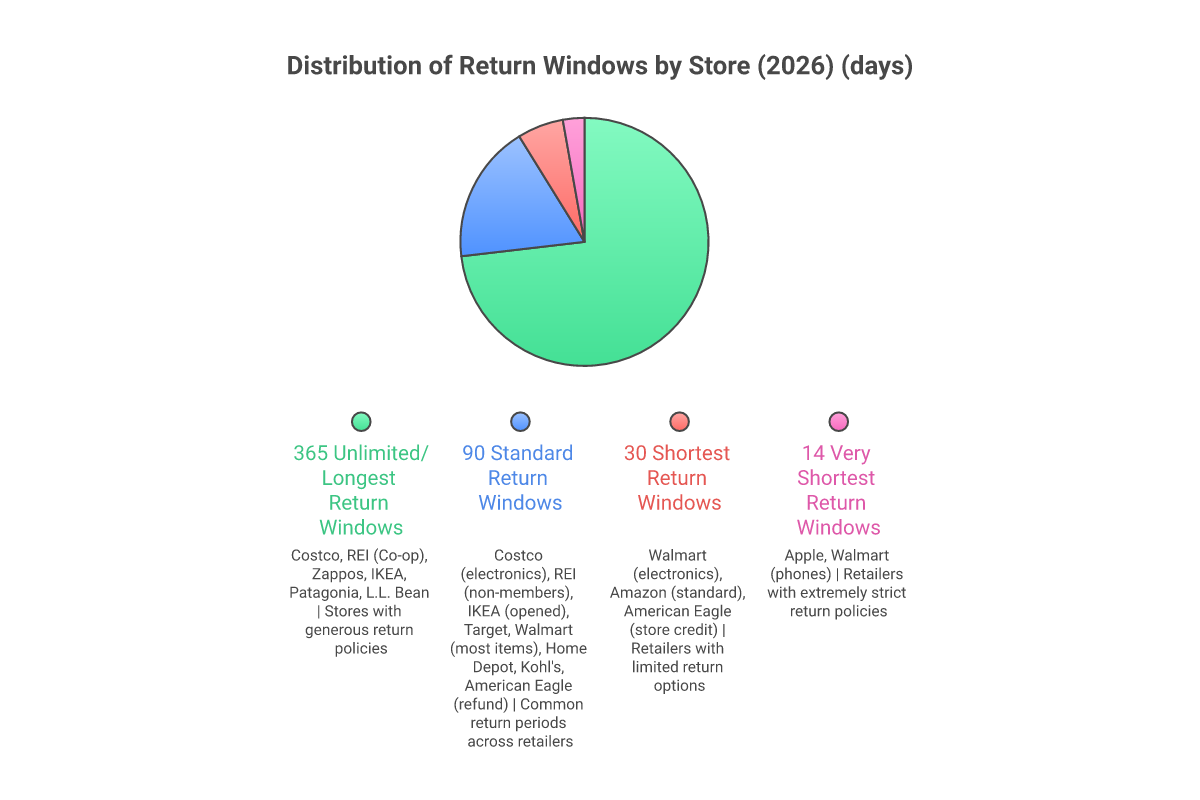
No other guide puts this all in one place. Here’s every major retailer side by side on the metrics that matter: window length, receipt rules, restocking fees, and free shipping.
| Store | Standard Window | Extended Window | Receipt Required? | Restocking Fee | Free Return Shipping |
|---|---|---|---|---|---|
| Costco | Unlimited (most items) | 90 days (electronics) | No (membership lookup) | No | Yes (online) |
| Bath and Body Works | No deadline | – | No | No | No |
| Patagonia | No formal limit | Credit after 1 year | Yes (for refund) | No | $7 (free for credit) |
| REI | 365 days (members) | 90 days (non-members) | No (member lookup) | No | $7.99 mail, free in-store |
| Zappos | 365 days | 60 days for payment refund | Order number | No | Yes |
| IKEA | 365 days (unopened) | 180 days (opened) | Yes (Family auto-track) | No | No |
| L.L. Bean | 1 year (any reason) | Defects only after | Yes or lookup | No | $6.50 (waived w/ Mastercard) |
| Target | 90 days | 120 days (RedCard), 365 days (own brands) | No (card/Circle lookup) | $35 (phones) | Yes |
| Walmart | 90 days | – | No (ID lookup) | No | Yes |
| Kohl’s | 90 days | 120 days (Kohl Card) | Optional | 15% (freight items) | No |
| Home Depot | 90 days | 365 days (HD Credit Card) | No (ID lookup) | 15% (special orders) | No |
| Amazon | 30 days | 90 days (Baby), 100 days (mattresses) | Digital (order history) | No (general) | Free at Kohl’s/Whole Foods |
| American Eagle | 30 days (refund) | 60 days (store credit) | Yes | No | $5 (free in-store) |
| Apple | 14 days | – | Yes | No | Yes (in-store) |
| Best Buy | 15 days | 30 days (Elite members) | Yes | 15% electronics, $45 phones | No |
Policies verified as of March 2026. Electronics often have shorter windows no matter the store.
What most guides miss is that “best return policy” is not one answer. Costco wins for household staples. REI wins for outdoor gear if you’re a Co-op member. Zappos wins for shoes if you’re buying within 60 days. The right policy depends entirely on what you’re buying.
Stores with Unlimited or 365-Day Return Windows
The most generous return policies come from a handful of retailers willing to take the long view. Here’s what each one actually offers, including the fine print that shorter guides skip.
Costco still leads the pack for everyday shoppers. Most products can be returned anytime for any reason. No receipt needed – your membership tracks every purchase. Electronics are the main exception: 90 days. The catch in 2026 is that Costco has started flagging accounts with high return frequency. It won’t boot you for a few returns, but serial returners are getting warnings. Fair enough, honestly.
REI offers 365 days for Co-op members (that’s a $30 one-time fee, worth it if you buy outdoor gear regularly). Non-members get 90 days. No restocking fees, and you can return in-store for free or pay $7.99 for a mail-in label. REI also covers products with a lifetime satisfaction guarantee if they fail from a factory defect.
Zappos gets credit for a 365-day window. There’s an important catch, though: refunds to your original payment go back only for the first 60 days. After that, you’re looking at store credit. Still very generous compared to most stores, but not quite the unlimited refund policy some people assume.
IKEA splits by condition: 365 days for unopened items, 180 days for opened ones. You need proof of purchase (IKEA Family card tracks this). No restocking fees, but you can’t ship returns back. In-store or pickup only.
Patagonia has no formal return deadline. The company will accept worn, used gear if there’s a quality issue. For most returns you need the original receipt; after a year, you get store credit rather than a cash refund. Return shipping costs $7, or free if you opt for store credit.
Bath and Body Works operates under a 100% satisfaction guarantee with no stated time limit. The company tightened enforcement in 2025-2026 on mostly-used candles – don’t expect to return a candle you’ve burned down to a nub. But for items that just didn’t work for you, the policy remains very consumer-friendly.
Stores with 90-Day Standard Return Windows
The 90-day window is the current retail standard, but the details vary a lot from store to store.
Target has one of the more layered policies on this list. RedCard holders get 120 days. Target’s own brands – like Cat and Jack kids clothing and Threshold home goods – get a full year. Drive Up returns – started in the app, done from your car – are now at all locations. There’s a $100 annual cap on no-receipt returns, and a $35 restocking fee applies specifically to phone returns.
Walmart’s 90 days covers most merchandise, with shorter windows for electronics (30 days) and phones (14 days). No restocking fees on standard returns, and Walmart+ members can now schedule doorstep pickup returns through the Walmart+ Returns from Home service. Without a receipt, you’ll get a gift card at the item’s lowest recent price – not a full refund.
Kohl’s cut its window from 180 to 90 days in 2025. A big drop if you were used to the old policy. The Kohl Card still gives you 120 days. Freight items have a 15% restocking fee, and return shipping costs money. Worth noting: without a receipt, Kohl’s gives store credit at the lowest price in the past 13 weeks. That can be a lot less than what you paid.
Home Depot runs 90 days for most items, stretching to 365 days for Home Depot Credit Card holders. Plants come with a one-year guarantee. Special orders carry a 15% restocking fee. And there’s a 48-hour window after appliance delivery to inspect for problems – miss that and it’s a warranty issue, not a return.
L.L. Bean gives you a full year for any return for any reason. After that, defects are handled under a separate warranty policy. The $6.50 return shipping fee is waived for L.L. Bean Mastercard holders. No restocking fees. Their policy is still one of the cleanest in retail even after they walked back the true lifetime guarantee years ago.
Tracking deals across hundreds of outdoor and apparel retailers, one pattern stands out: stores with strong loyalty cultures – REI, L.L. Bean, Patagonia, Zappos – tend to maintain generous return policies longer. They’re betting on long-term loyalty rather than cutting short-term return costs. It’s a strategy that shows up clearly in their numbers.
Stores with Shorter Return Windows
Shorter doesn’t always mean worse. Context matters here.
Amazon’s standard 30-day window looks stingy compared to the rest of this list. But Amazon has the most flexible return mechanics. Drop-offs at Kohl’s and Whole Foods are free, returnless refunds have grown for cheap items (you keep it AND get a refund), and Baby items get 90 days while mattresses get 100. Your entire order history serves as your receipt. For most everyday purchases under $30, Amazon’s process is faster and easier than any other store on this list.
Apple gives you just 14 days from purchase. No exceptions for engraved items or opened software. Apple’s in-store experience is notably smooth – staff are trained to process returns quickly, no attitude, no restocking fee. AppleCare also means many problems get fixed as repairs rather than returns. Holiday purchases from November 12 to December 25, 2025 got an extension to January 8, 2026.
American Eagle used to have one of the more open-ended policies in apparel. That changed. Returns are now capped at 30 days for a full refund back to your original payment, and 60 days for store credit. Online returns cost $5 in return shipping; in-store is free. Not terrible, but a noticeable step back from what it used to be.
Hidden Costs: Restocking Fees and Return Shipping Charges
This is the section most return policy guides skip. They’ll tell you the return window, but not what the return actually costs you.
Return Costs by Retailer
In-store returns are usually free – costs below apply to mail or ship returns
Best Buy (phones/tablets)$45 flat fee
Best Buy (general electronics)15% restocking
Kohl’s (freight items)15% restocking
Home Depot (special orders)15% restocking
REI (mail-in)$7.99
L.L. Bean (mail-in)$6.50
American Eagle (mail-in)$5.00
Amazon (UPS if no free option nearby)$1.00
In-store returns are usually free at all retailers above
Best Buy charges a 15% restocking fee on most electronics and a flat $45 on phones and tablets. That’s not a typo. Return a $300 phone to Best Buy and you might pocket $255 – not $300. Always factor this in before buying electronics there unless you’re certain you’ll keep it.
The rule for deal-seekers: return in-store when you can. Mail-in fees are almost always avoidable. Amazon is the easy win – free drops at any Kohl’s or Whole Foods location, and those are everywhere. A $1 charge applies only if you use UPS and a free location is geographically closer.
Here’s something most return policy guides skip: store credit card holders aren’t exempt from fees either. Kohl’s charges 15% on freight items no matter how you paid. And any shipping surcharges you paid on delivery don’t come back. Before you place a large order with a freight option, check the return fee first.
No Receipt? Here’s What Happens at Each Store
Lost your receipt? In most cases, you’re still fine – if you used a credit card, loyalty account, or membership at the time of purchase.
Costco is the cleanest no-receipt experience: your membership is the receipt. Every purchase is tracked, and returns are processed against that history. No limits, no ID required beyond membership verification.
Target can look up purchases made with your RedCard or Circle loyalty account. Without those, Target will still process returns but caps no-receipt returns at $100 per calendar year, and may require a valid government ID.
Walmart handles no-receipt returns with a valid photo ID. You get a gift card at the item’s lowest recent price – not what you paid. If the item went on sale after you bought it, you could end up with less than you spent.
Nordstrom can look up purchases by credit card or ID. Without documentation, returns become store credit at the current selling price. Nordstrom’s staff is usually flexible, but the 45-day refund window still applies.
Kohl’s issues store credit for no-receipt returns, at the lowest price in the past 13 weeks. If you bought during a sale and prices went back up, you’re fine. But if you paid full price for something that’s been on sale since, you’ll get less than you paid.
Home Depot takes no-receipt returns with a valid ID and gives store credit at the current price, usually as a merchandise card.
Most stores now need a government ID for no-receipt returns. Many track your return history by that ID too. Too many returns without docs and some retailers will flag you. Store apps and loyalty programs fix this – your purchase history is always there when you need it.
Major Return Policy Changes in 2025-2026
This part is for anyone working with outdated information. Several major policies changed quietly, without much consumer notice.
Nordstrom made the biggest shift: from an essentially unlimited return policy to a 45-day window for full refunds. After 45 days, returns are handled case-by-case at Nordstrom’s discretion. This is a shift even longtime Nordstrom fans may not know about. The brand built its reputation on no-questions-asked returns. That era is over.
Kohl’s cut its return window from 180 days to 90 days in 2025. If you were used to having 6 months, you now have 3. The Kohl Card still earns you 120 days, but even that is half the old base policy.
American Eagle dropped its open-ended policy. Now it’s a structured system: 30 days for cash refunds, 60 days for store credit only. That’s a significant tightening.
Costco hasn’t changed its policy language, but enforcement tightened against high-frequency returners in 2025-2026. Accounts with high return rates are getting flagged. Some memberships have been revoked. The policy is still among the best out there, but returning things endlessly is no longer realistic.
Zappos shifted refund-to-payment availability to the first 60 days. You still get 365 days to return, but after day 60 it’s store credit only. The window didn’t shrink – the financial terms inside it did.
Walmart went the other direction, adding convenience: the Walmart+ Returns from Home service lets members schedule doorstep pickup for returns. And Target’s Drive Up return option became standard at all locations, letting you initiate and complete a return from your car via the app.
The cause of all this is return fraud. 85% of retailers now use AI to catch return fraud. The industry has gotten much more systematic about this. Regular shoppers with normal return habits are generally fine. But the days of truly no-questions-asked policies at major chains are largely behind us.
Holiday Return Policies: Extended Deadlines for Gift Shoppers
Gift-givers get extra time at most major retailers, but extensions vary and electronics are often excluded.
For the most recent holiday season, here’s what the major retailers offered:
- Amazon: Items purchased November 1 through December 31 were returnable through January 31.
- Target: November and December purchases were eligible through January 24, 2026.
- Kohl’s: Holiday returns through January 31, 2026 for items bought during the holiday window.
- Apple: Items bought November 12 to December 25, 2025 got an extension to January 8, 2026 – shorter than most retailers.
- Best Buy: Extended holiday window, but specific electronics categories were excluded.
Always check holiday-specific return deadlines before gifting anything with a short standard window. Electronics, phones, and gaming equipment are often the most restrictive, and those tend to be the highest-value gifts. If you’re buying an Apple product as a gift, confirm the exact holiday extension dates on Apple’s website before assuming you have until January 31.
One more nuance: the holiday extension typically applies to the date of purchase, not the date of gifting. If you bought something in October assuming it would fall under holiday rules, it usually won’t.
Tips for Hassle-Free Returns
The difference between a smooth return and a painful one usually comes down to preparation, not policy.
Use store apps and loyalty accounts to auto-track purchases. This is the single most useful change most shoppers can make. Target Circle, Walmart app, Kohl’s app, Costco membership – all of these create a digital receipt. You can always look up what you paid and when you bought it. No digging through email. No holding onto paper receipts.
Keep original packaging until you’re sure about the item. This matters most for electronics, which often need the original box to qualify for a return at all. A 30-day window on a product you opened and re-packed poorly is effectively zero days.
Know the return timeframe before you buy, especially for electronics. Best Buy gives 15 days for most electronics. Apple gives 14. If you’re buying a gift in early November, those windows may expire before the item is even opened. Either buy later or confirm you’re inside a holiday extension window.
Return in-store whenever possible. Free is almost always available in-store. Mail-in fees at REI, L.L. Bean, and American Eagle are all avoidable by walking into a location. For Amazon, Kohl’s drop-off locations are pretty much everywhere.
Use credit card purchase protection as a backup. Many Visa Signature and Mastercard World cards extend return windows by 90 days beyond the store’s limit. If a store won’t take it back, check your card benefits. File a claim if coverage applies.
Consider store credit cards for extended windows. Target RedCard adds 30 days to the standard window. Kohl’s Card adds 30 days. Home Depot Credit Card extends by 275 days. These extras matter most for appliances, seasonal buys, and big purchases.
We process thousands of coupon codes and deals each week. One thing keeps showing up: shoppers with loyalty accounts have far fewer return problems. Not because they return less, but because the purchase history is always there. The friction disappears.
How We Ranked These Return Policies
To put this together, our team reviewed official retailer policy pages in March 2026. The criteria: window length, receipt rules, restocking fees, free shipping, no-receipt options, and recent changes.
The best policy overall depends entirely on what you’re buying. For general merchandise at a warehouse club, Costco is still unmatched. For outdoor gear, REI’s member policy is the best deal around. For shoes, Zappos runs the longest window with the easiest process. For home goods, IKEA’s year-long unopened window is hard to beat.
Generous policies sometimes have a catch. REI’s $30 fee is one-time, not annual – a bargain if you buy outdoor gear with any regularity. Costco’s annual fee ($65 or $130 depending on tier) gets you more than just return flexibility. It’s worth thinking about which stores you shop at most and planning around that.
A quick note on our method: we reviewed public return policies and checked against industry reports for 2025-2026 changes. We don’t have a financial relationship with any store listed. If you’re making a big purchase, always verify the current policy on the store’s website. Policies change.
The Bottom Line
For most shoppers, Costco offers the best overall return policy in 2026 – unlimited windows on most items with no receipt needed. But the right answer depends on what you buy: REI for outdoor gear (365 days for Co-op members), Zappos for shoes and apparel (365 days, with 60 days for cash refunds), and Target for everyday household items (90 days with broad product extensions). The main thing to know is this: at least 6 major retailers tightened policies in 2025-2026. Always check the return window before you buy, especially for electronics and big purchases where restocking fees can cut into your refund.
Frequently Asked Questions
Which store has the most generous return policy overall?
Costco still has the most generous policy for most product types – unlimited returns on most items, membership-tracked purchases (no receipt needed), and no restocking fees. Electronics are capped at 90 days, and the company has started flagging accounts that return things too often. For shoes and apparel specifically, Zappos and REI (for Co-op members) both offer 365-day windows that match or beat Costco’s.
Can you return items without a receipt?
Yes, at many major retailers. Costco, Target, and Walmart all have lookup systems tied to your membership or card. Nordstrom and Home Depot can process returns with a valid government ID. The catch: the refund may be store credit at the current price, not what you originally paid. Most stores now track no-receipt returns by ID to limit abuse.
What is a restocking fee and which stores charge them?
A restocking fee is taken out of your refund when you return certain items – usually electronics, big appliances, or special orders. Best Buy charges 15% on most electronics and a flat $45 on phones and tablets. Kohl’s charges 15% on freight items. Home Depot charges 15% on special orders. Most other major retailers don’t charge restocking fees on standard items, but always check before any large or specialized purchase.
Do return policies change during the holiday season?
Most major retailers extend their standard windows for holiday purchases. Amazon, Target, and Kohl’s all extend returns for November and December purchases through late January. Apple extends through early January. Electronics are often cut out of holiday extensions even when other items qualify. Check the specific holiday policy before gifting anything with a short standard window.
Are online returns different from in-store returns?
Yes, often. In-store returns are almost always free. Mail-in returns cost money at REI ($7.99), L.L. Bean ($6.50), American Eagle ($5), and others. Amazon is different – free drop-offs at Kohl’s and Whole Foods make online returns free for most people. Walmart+ members can now schedule doorstep pickup returns. Target Drive Up returns work from your car, which makes the process nearly as convenient as in-store.
Can stores ban you for making too many returns?
Yes. Costco has been flagging people who return too much and, in some cases, revoking memberships. Most major retailers track return history by membership account or government ID. High return rates trigger reviews or restrictions. Average shoppers aren’t affected. But the unlimited goodwill of the “return anything” era is gone at most chains.
Sources
- National Retail Federation – 2025 Returns Announcement: US retail returns totaled $849.9 billion in 2025, representing 15.8% of total sales
- NRF 2025 Returns Report: 82% of shoppers say free returns influence purchase decisions; 71% avoid retailers after bad return experiences
- Forbes – Retail Returns Challenge 2026: Return fraud cost $103 billion in 2024, 9-15% of all returns
- Yahoo Finance – Free Returns Study: 72% of merchants now charge for at least some returns, up from 66%
- Radial – Retailer Returns Challenges 2026: 85% of retailers now use AI for return fraud detection
- Newsweek – Costco Return Policy Changes: Costco flagging high-frequency returners in 2025-2026
- Oreate AI – Nordstrom Return Policy Change: Nordstrom shifted from unlimited to 45-day refund window
- NY Post – Retailer Return Fees 2025: Best Buy charges 15% restocking fee on electronics, $45 on phones/tablets
Do You Have Any Suggestions?
We're always looking for ways to enrich our content on DontPayFull.com. If you have a valuable resource or other suggestion that could enhance our existing content, we would love to hear from you.
Was this content helpful to you?
Related Articles