5.00 out of 2 votes
Best Time to Buy a Laptop: Sale Seasons, Price Trends, and Smart Timing (2026)
Find out when to buy a laptop for the best price in 2026. November Black Friday deals cut 21-35% off retail, but tariffs and chip shortages are reshaping the usual windows. Learn which months to target and how to stack coupons for maximum savings.
Key Takeaways
- ✓ Black Friday and Cyber Monday remain the best time to buy a laptop, averaging 21-35% off with doorbusters reaching 40-50%.
- ✓ 2026 is a uniquely expensive year: AI-driven DRAM shortages and US tariffs have pushed some laptop prices up 20-40% from their 2025 baseline.
- ✓ September and October are the worst months to buy. New models launch at full MSRP and there are essentially no discounts.
- ✓ Post-CES January clearance is an underrated window, especially if you’re happy with a previous-generation model at 14-17% off.
- ✓ Stacking a coupon code on top of a sale price can push your savings well past what any single discount event achieves on its own.
Is there actually a right time to buy a laptop, or is that just something deal blogs say to get clicks? Here’s the honest answer: yes, timing matters. And in 2026, it matters more than it has in years. Component prices are surging, tariffs are adding pressure at the border, and retailers are playing creative games with “original” prices. If you walk into a purchase blind this year, you’ll pay a lot more than you need to.
This guide breaks down every major sale window and the months to avoid. We also cover angles most competitors miss entirely, including refurbished timing and coupon stacking.
Our team regularly tests the deals mentioned in this article. Updated seasonally.
Why Timing Your Laptop Purchase Matters More in 2026
Laptop pricing in 2026 is the most volatile it’s been in a decade. AI-driven memory and DRAM shortages have pushed component costs up 20-40% compared to recent norms. 32GB DDR5 RAM went from roughly $90 to $350 as data centers competed for the same chips consumers need. IDC expects average PC prices to climb by up to 8% in 2026, though analysts tracking memory-heavy configs put the number much higher.
US trade policy adds another layer. About 80% of US-bound laptops come from China, and the tariff structure means manufacturers are passing costs directly to buyers. Acer’s CEO publicly confirmed a 10% price hike tied to tariffs. The Consumer Technology Association modeled the impact at $150-$270 extra per laptop on certain models.
So yes, you could buy a laptop any month and get something that works. But smart timing can offset 20-35% of that cost through sale events alone. That’s real money.
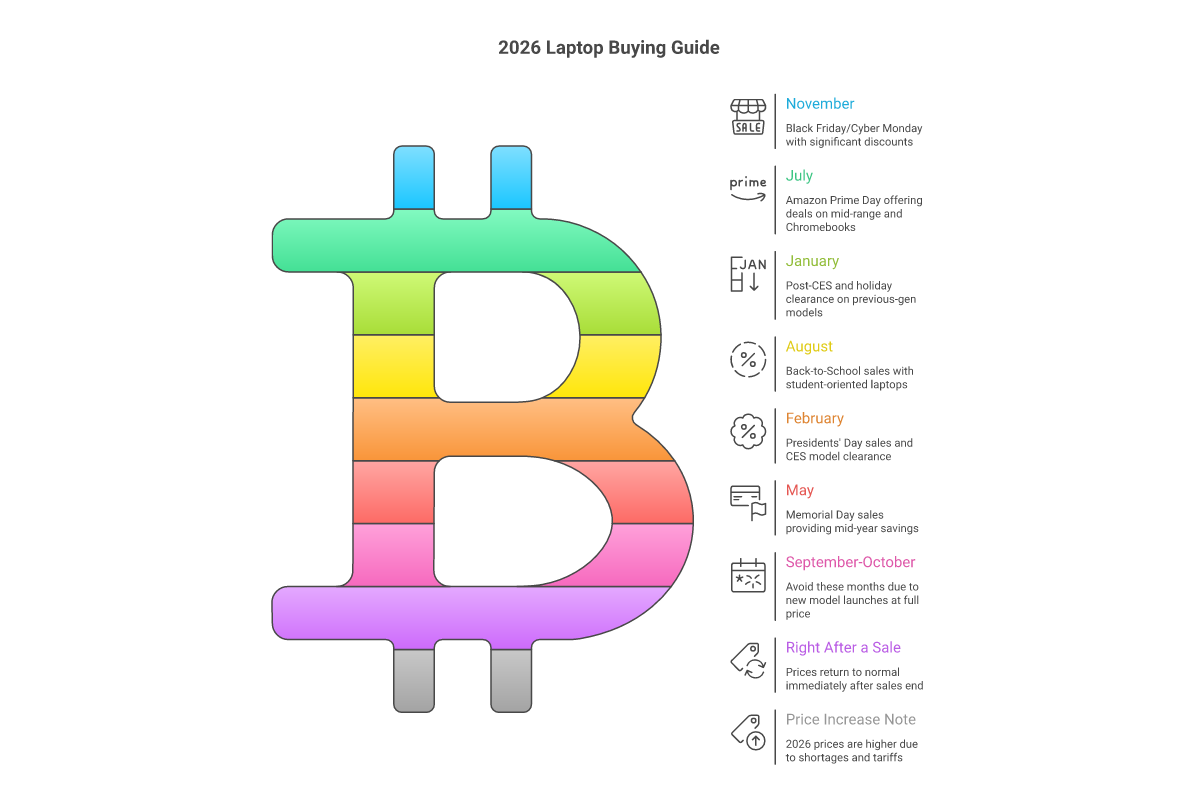
The Best Months to Buy a Laptop: A Seasonal Calendar
The cheapest month to buy a laptop is November. Black Friday and Cyber Monday combine to push average discounts to 21-35% off MSRP, with some doorbuster deals hitting 40-50%. November isn’t the only window worth watching, though.
Here’s how the year breaks down:
Average Laptop Discounts by Month
Based on historical sale event data from ShopSavvy and PriceMirage
November (Black Friday / Cyber Monday)
21-35% off
21-35% off
July (Amazon Prime Day)
14-20% off
14-20% off
January (Post-Holiday Clearance)
14-17% off
14-17% off
August (Back-to-School Peak)
8-22% off
8-22% off
Holiday Weekends (Presidents’ Day, Memorial Day)
10-20% off
10-20% off
September-October (New Model Season)
0-5% off
0-5% off
What most guides miss is the January “double dip”: post-CES inventory movement and post-holiday clearance both happen at once. Two reasons for retailers to move old stock fast.
Black Friday and Cyber Monday: The Biggest Laptop Discounts of the Year
Black Friday is the best time to buy a laptop. Average discounts of 21-35% off MSRP are the norm, and the best deals can push well past 40%. Last year, the M4 MacBook Air dropped to $738 (a 26% discount), and Microsoft Surface laptops were marked down by 38%. Dell and Asus models saw $150-$470 off list price during competing sale events that same window.
One timing detail worth knowing: the “Black Friday” deals season now starts in late October. Retailers have been front-loading discounts for several years, partly to capture sales earlier and partly because the actual Thanksgiving weekend risks stockouts on popular models. If you wait for the Friday itself, the best models are often gone.
💡
Tip: Black Friday deals go live on major retailer sites before midnight. Set a price alert 2-3 weeks out so you catch the early drops, not just the day-of rush.
The logic behind the deep discounts is straightforward: retailers need to clear inventory before the new models announced at CES (early January) arrive in stores around March and April. Older models become dead weight once the new generation ships. That urgency is your chance to save.
Tracking deals across hundreds of stores over multiple Black Friday seasons, the pattern is clear: the deepest discounts almost always land on the previous generation’s mid-range models, not the current flagships. Flagships get modest discounts to protect margins. It’s the $899 machine from eight months ago that goes to $599.
Amazon Prime Day and Back-to-School Season
Amazon Prime Day, typically in mid-July, averages 14-20% off laptops. That’s a real discount but a noticeably smaller window than Black Friday. The sweet spot for Prime Day is Chromebooks and mid-range Windows laptops. High-end flagships rarely see the same treatment.
The effect on other retailers is almost as important as the Amazon deals themselves. Best Buy, Walmart, and maker sites like Dell and HP routinely run competing sales during Prime Day week to avoid losing customers. So even if you don’t shop on Amazon, Prime Day creates a discount moment worth tracking across the board.
Back-to-school runs from roughly June through early September and delivers savings of 8-22% on student-oriented laptops. Apple’s angle here is different from a straight discount. The Apple Store runs gift card promotions from June through October for back-to-school season. There’s also year-round education pricing, which takes around $100 off select MacBook models for students and teachers. Not a clearance sale, but it’s worth checking if you qualify.
Holiday Weekend Sales: Presidents’ Day, Memorial Day, Labor Day, and July 4th
Federal holiday weekends deliver above-average discounts in what would otherwise be flat pricing months. They won’t match Black Friday, but 10-20% off during a stretch when deals are rare is worth planning around.
Presidents’ Day (February) is a solid option because it overlaps with early stock movement on CES-announced models. Retailers want to thin out existing inventory before the new arrivals land, so you get clearance pricing on current-generation machines plus a few early deals on whatever launched at CES.
Memorial Day (May) and Labor Day (September) bookend the summer season with sale windows. Memorial Day tends to have better laptop deals than Labor Day, simply because September overlaps with new model launches, which push prices back up. July 4th often blends with early back-to-school sales for a modest mid-summer dip.
These aren’t huge savings events. But if you can’t wait for Black Friday and your current laptop is dying, these weekends are the next-best option.
Post-CES January Clearance: The Underrated Window
Every January, CES in Las Vegas becomes the main stage for new Windows laptop announcements. Intel, AMD, and Qualcomm reveal new processors; Lenovo, HP, Dell, and Asus announce the models that will ship in spring. That creates an immediate pricing problem for retailers still holding last year’s stock.
Clearance discounts on previous-generation models average 14-17% in January and February. Post-holiday returns also flood the refurbished market in January. That combo makes it one of the better months to find a solid deal on a capable machine that’s just not brand new.
Apple doesn’t follow the CES calendar. MacBook launches cluster in spring (March/June) and fall (October/November), so January clearance plays out differently for Apple products. Microsoft Surface follows its own 2-year refresh cycle, usually aligned with spring or fall events. If you’re set on a Mac, the timing logic shifts a lot.
When to Buy a Gaming Laptop
Gaming laptops run on a slightly different clock. New Nvidia RTX generations typically land at CES or spring, which is when prices on current-gen gaming laptops are highest. Wait 3-4 months after a new GPU generation launches for the market to normalize.
Black Friday offers the deepest gaming laptop discounts, typically 20-30% off mid-range models. Back-to-school can be hit-or-miss. Some retailers discount slow-moving gaming stock to make room for fall arrivals. The savings are inconsistent, though. It depends on which models the retailer happens to be sitting on.
Here’s something you won’t find in other roundups: gaming laptop prices at launch of a new GPU generation don’t just stay high, they sometimes go up briefly as demand outstrips supply. If you’re watching a gaming laptop and see the price tick up right after a new GPU announcement, that’s normal. Hold off 6-8 weeks before checking again.
⚠️
Attention: Avoid buying any gaming laptop in January-March if Nvidia has just announced a new RTX generation. Prices are at their peak and the new GPU’s models may still be weeks from shipping.
Where to Buy: Retailer Comparison for the Best Laptop Deals
Knowing when to buy is half the equation. Knowing where matters too, and the right retailer depends on which laptop you’re after.
| Retailer | Best For | Watch Out For |
|---|---|---|
| Best Buy | Widest selection, Copilot+ exclusives, strong BF deals | In-store prices don’t always match online |
| Amazon | MacBook deals, broad Prime Day discounts | Inflated “original” prices on third-party listings |
| Walmart | Budget laptops, some exclusive Apple deals | Limited mid-range and premium inventory |
| Dell.com / HP.com / Lenovo | Unique sale events, student/military discounts, clearance | Harder to compare across retailers |
One thing Mashable documented that’s worth flagging: some retailers inflate the “original” MSRP to make the discount look bigger than it is. Worth checking. Always cross-check the listed “original price” against the manufacturer’s website and one other retailer before assuming you’re getting 30% off.
DontPayFull tracks active coupon codes for Best Buy, Amazon, Walmart, Dell, HP, and Lenovo. Stacking a working coupon on top of a sale price is one of the highest-value moves in this whole guide. Most deal guides don’t mention it because they don’t have the coupon inventory to back it up.
21-35%
Black Friday avg. discount
14-20%
Amazon Prime Day avg.
8-22%
Back-to-school range
0-5%
Sept-Oct new model season
How to Track Prices and Set Up Deal Alerts
Knowing the best windows means nothing if you’re not watching prices. These tools actually work:
CamelCamelCamel tracks Amazon price history and sends email alerts when a specific laptop drops to your target price. It shows the full price history so you can tell whether that “sale price” is actually low or just back to normal.
Google Shopping Insights lets you compare the same model across retailers. It won’t catch every seller, but it’s a fast sanity check before you buy.
The DontPayFull extension tests coupon codes at checkout without you having to hunt for them. On a laptop purchase, even a 5% code on top of a sale price adds up fast.
Set alerts 2-4 weeks before expected sale events to catch early price drops. Black Friday deals often start trickling out in late October. If you’re watching from November 1st, you might miss the first wave.
Refurbished and Open-Box Laptops: Timing for Extra Savings
Most guides ignore refurbished laptops entirely. That’s a real oversight. The refurbished market has its own timing logic and can save you more than any standard sale event.
Apple Certified Refurbished consistently offers 15-20% off with a full one-year warranty and the same build quality as new. Best Buy Open Box deals give 10-25% off floor models and returns. Amazon Renewed comes with a 90-day guarantee on refurbished laptops.
Here’s the timing angle: January and February see the highest volume of holiday returns flow into certified refurbished inventory. Wait 2-4 weeks after Christmas and you’ll often find a much wider selection of near-new laptops at refurbished prices. On certain models, those prices beat Black Friday.
From what we’ve seen tracking the refurbished laptop category, Apple’s refurbished store replenishes fastest in the weeks after major product launches, not during sale events. If you missed a launch price and want the previous generation, January and June tend to have the most options.
The Worst Times to Buy a Laptop
Best Times to Buy
- + November (Black Friday / Cyber Monday)
- + July (Amazon Prime Day)
- + January (post-CES + post-holiday clearance)
- + August (back-to-school peak)
- + Holiday weekends (Presidents’ Day, Memorial Day)
Worst Times to Buy
- − September-October (new model launches)
- − Days right after a sale ends
- − First 2-3 months of a new product line
- − March-May (outside holiday weekends)
Not all bad months look the same. Some windows are easily avoidable if you know what to watch for.
September and October are the worst months to buy a laptop, full stop. New models launch at full MSRP and there are almost no discounts at all. Retailers have no reason to cut prices when brand-new stock is selling at list price.
Right after a major sale event ends is another trap. Prices normalize or increase within days of a sale window closing. If you missed Black Friday, don’t buy on December 2nd hoping for stragglers. Either wait for January clearance or buy at regular price with a coupon code stacked on top.
The first 2-3 months of a brand-new product line always carry an early-adopter premium. New MacBook Air generation, new Intel Core Ultra tier, doesn’t matter. Launch prices are the highest those models will ever sell for. Patience pays off.
The Bottom Line
If you can wait, November’s Black Friday and Cyber Monday window is the clear answer, averaging 21-35% off with some deals reaching 40-50%. If November is too far away, January’s post-CES clearance and July’s Prime Day are the next-best options. Either way, avoid September and October entirely. And in 2026 specifically, with prices elevated by AI-driven component shortages and US tariffs, a coupon code stacked on top of a sale price is one of the few moves that can close the gap to what you’d have paid two years ago.
Frequently Asked Questions
What is the cheapest time of year to buy a laptop?
November is the cheapest month overall, with Black Friday and Cyber Monday discounts averaging 21-35% off and some deals reaching 40-50%. If you can’t wait until November, July (Amazon Prime Day) and January (post-holiday clearance plus post-CES inventory movement) are the next-best windows.
Which month is best to buy a laptop?
November leads for sheer discount depth. For a reliable second option, January delivers 14-17% off on previous-generation models as retailers clear inventory ahead of new spring stock. July is best if you need mid-range or Chromebook deals. August works well for student laptops. For a full view of upcoming sale events, see the 2026 shopping calendar.
Should I buy a laptop now or wait for prices to drop in 2026?
That depends on when you’re reading this. If you’re in September or October, wait. Those are the most expensive months with basically no discounts. If you’re in the November-January window or July, you’re in a good buying moment. In 2026 specifically, Wired noted that the “laptops have never been cheaper” trend from 2025 may be reversing. Waiting for prices to broadly fall isn’t a reliable strategy this year.
How much can you save buying a laptop on Black Friday?
On average, 21-35% off MSRP. In real dollar terms, that translated to $150-$470 off Dell and Asus models last year, and a 26% discount on the M4 MacBook Air (from $999 down to $738). The best deals are on previous-generation mid-range models.
Is it cheaper to buy a laptop online or in-store?
Online is usually cheaper or equivalent, and makes price comparison much easier. In-store does let you see the machine before buying, and some Best Buy deals aren’t available online. That said, cross-checking at least three online sources before buying in-store is the smarter move.
How long does a laptop typically last before you need a replacement?
Most mainstream laptops last 4-6 years before the hardware starts limiting what software you can run. High-end models like MacBook Pro or ThinkPad X-series routinely go 7-8 years with maintenance. Knowing your current machine’s age is actually useful context when deciding whether to buy now or wait for the next sale window.
Sources
- Tom’s Hardware: Laptop Prices Expected to Soar by Around 40%: Analysis of AI memory shortage impact on laptop pricing (2026)
- IDC via Yahoo Tech: PC Price Increases 2026: IDC forecast for average PC price increases in 2026
- Tom’s Hardware: Acer CEO Tariff Price Rise: Acer CEO confirms 10% price hike from US tariffs; 80% of US laptops manufactured in China
- Consumer Technology Association: Tariff Impact on Consumer Technology: CTA modeling of $150-$270 per laptop price increase from tariffs
- ShopSavvy: Best Time to Buy Laptops: Historical discount data by month and sale event
- PriceMirage: Best Time to Buy a Laptop 2026: Month-by-month breakdown of best and worst months with discount ranges
- Forbes: Black Friday Laptop Deals: Black Friday 2025 laptop deal examples including MacBook Air pricing
- NY Post: Best Amazon Prime Day Laptop Deals: Prime Day 2025 laptop discounts on Dell and Asus
- Mashable: When to Buy a Laptop: Retailer comparison and inflated MSRP documentation
- Wired: Laptops Have Never Been Cheaper: 2025 pricing trend context and 2026 reversal warning
- Gadget Salvation: 2026 Global Laptop Price Surge: DDR5 RAM pricing surge analysis ($90 to $350)
Do You Have Any Suggestions?
We're always looking for ways to enrich our content on DontPayFull.com. If you have a valuable resource or other suggestion that could enhance our existing content, we would love to hear from you.
Was this content helpful to you?
Related Articles