No votes yet.

Consumer Price Index Trends: Key Statistics and Data (2026)
CPI data from 1913 to 2026: current readings, category breakdowns, and how consumer price index trends affect Social Security, wages, and daily spending.
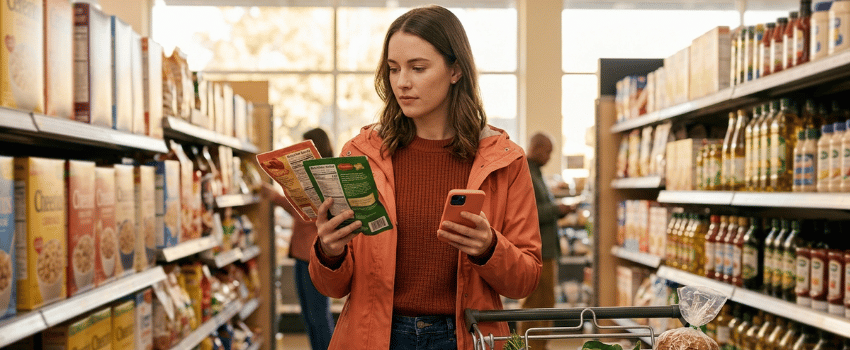
You’re standing in the cereal aisle, holding the same box of granola you’ve bought for three years. The price reads $7.49. You remember it used to be $5.19. You put it back and grab the store brand instead. That quiet swap, repeated millions of times a day across every grocery store in America, is exactly what the Consumer Price Index was built to track.
The DontPayFull Research Team compiled this guide using primary data from the Bureau of Labor Statistics, Eurostat’s G20 dataset, the Federal Reserve Bank of Minneapolis historical records, and a U.S. Government Accountability Office report on shrinkflation. All statistics reflect the most current publicly available releases at the time of writing.
Key Takeaways
- ✓ US CPI peaked at 9.1% year-over-year in June 2022, the highest reading since November 1981, before falling back to 2.8% YoY in February 2026.
- ✓ Shelter costs represent roughly 36% of the total CPI basket and have been the primary reason inflation has stayed above the Fed’s 2% target since mid-2023.
- ✓ Core CPI (excluding food and energy) was 3.1% YoY in February 2026, still elevated above headline because services like rent and insurance remain sticky.
- ✓ US prices have risen roughly 35% cumulatively since 2015 (index: 135.4 in early 2026 vs. baseline 100), slightly above the EU27 but well below Brazil, India, and Russia.
- ✓ Shrinkflation contributed less than 0.1 percentage point to the 34.5% total price increase from January 2019 to July 2024, per a GAO study, meaning most of what you paid extra was genuine price inflation.
What Is the Consumer Price Index? (Overview)
The Consumer Price Index is the most widely cited measure of inflation in the United States. Published monthly by the Bureau of Labor Statistics since 1919, it tracks price changes for a fixed basket of goods and services paid by urban consumers, and covers approximately 93% of the US population.
CPI Overview Statistics
- The Bureau of Labor Statistics has published the Consumer Price Index monthly since 1919, giving the US over a century of continuous inflation data.
- CPI-U (All Urban Consumers) covers 93% of the US population, while CPI-W (Urban Wage Earners) covers roughly 29% and is used to calculate Social Security cost-of-living adjustments.
- BLS price collectors gather approximately 80,000 price quotes per month from roughly 23,000 retail and service establishments across the country.
- The CPI basket is organized into 8 major expenditure categories: food and beverages, housing, apparel, transportation, medical care, recreation, education and communication, and other goods and services.
- BLS releases CPI data 12 times per year, typically about two weeks after the reference month ends.
- CPI weights are updated annually since 2023, a change from the previous biennial update schedule, which makes the index more responsive to shifts in spending patterns.
- The base period for the standard CPI-U index is 1982-84 = 100, meaning a current reading of 327 reflects prices roughly 3.27 times higher than the 1982-1984 average.
Two versions of the index matter most. CPI-U covers all urban consumers and is the headline number you see in news reports. CPI-W tracks urban wage earners and clerical workers. That’s the version the Social Security Administration uses to set annual cost-of-living adjustments. Both use the same base period (1982-84 = 100). When you see a reading of 327, prices are roughly three times higher than in the early 1980s.
But here’s something most CPI explainers skip: the basket the BLS tracks is huge. Over 80,000 price quotes flow in every month. Collectors visit grocery stores, gas stations, rental offices, hospitals, and hundreds of other places across 87 urban areas. That’s not a small sample. It’s the real thing.
The index has real limits, too. It doesn’t fully capture quality changes. A laptop that costs $800 today is much faster than an $800 laptop from ten years ago, but BLS adjusts for that. Rural households aren’t covered. Retirees on fixed incomes spend money differently than the average urban consumer. The CPI gives you a useful national average. Your own experience may vary.
Current CPI Data (2025-2026)
As of February 2026, the US CPI-U stood at 327.460 (seasonally adjusted), up 2.8% year-over-year on a not-seasonally-adjusted basis and 0.2% month-over-month on a seasonally adjusted basis. That’s the smallest 12-month gain since February 2021, per the Bureau of Labor Statistics.
Current CPI Statistics (2025-2026)
- US CPI-U reached 327.460 in February 2026 (seasonally adjusted), up 2.8% year-over-year on an unadjusted basis, the smallest 12-month increase since February 2021.
- Core CPI (excluding food and energy) rose 3.1% year-over-year in February 2026, reflecting persistent services inflation even as goods prices softened.
- Shelter costs increased 4.2% year-over-year in February 2026, the single largest driver of above-target inflation.
- Food at home (grocery prices) rose 1.9% year-over-year in February 2026, while food away from home (restaurants) climbed 3.4%.
- The energy index fell 0.2% year-over-year in February 2026, providing downward pressure on headline CPI.
- Used cars and trucks fell approximately 3.0% year-over-year in early 2026, continuing a multi-year deflation trend in that category.
- Apparel prices dropped approximately 0.5% year-over-year in early 2026, making clothing one of the few categories showing outright deflation.
- The full-year CPI average for 2025 was 2.7%, down slightly from 2.9% in 2024, per BLS year-in-review data.
The table below shows monthly CPI-U index values (seasonally adjusted, series CUSR0000SA0) from January 2024 through February 2026, sourced from the Bureau of Labor Statistics API.
| Period | CPI-U Index (1982-84=100) | Period | CPI-U Index (1982-84=100) |
|---|---|---|---|
| Jan 2024 | 312.332 | Feb 2025 | 322.548 |
| Feb 2024 | 313.573 | Mar 2025 | 323.663 |
| Mar 2024 | 315.133 | Apr 2025 | 323.946 |
| Apr 2024 | 315.697 | May 2025 | 324.188 |
| May 2024 | 316.109 | Jun 2025 | 324.277 |
| Jun 2024 | 316.178 | Jul 2025 | 324.619 |
| Jul 2024 | 316.440 | Aug 2025 | 325.027 |
| Aug 2024 | 316.872 | Sep 2025 | 325.597 |
| Sep 2024 | 317.419 | Oct 2025 | 326.217 |
| Oct 2024 | 318.069 | Nov 2025 | 326.853 |
| Nov 2024 | 318.981 | Dec 2025 | 327.080 |
| Dec 2024 | 319.489 | Jan 2026 | 327.078 |
| Jan 2025 | 320.999 | Feb 2026 | 327.460 |
So what’s actually driving the 2.8% headline number? Shelter is doing most of the heavy lifting, contributing a disproportionate share of the increase relative to its basket weight. Energy is pulling in the other direction. Used vehicles, apparel, and some electronics are in outright deflation territory. The story is really two economies in one: services still running hot, goods increasingly cooling off.
From tracking deals across hundreds of stores, a pattern keeps showing up: coupon redemption rates for grocery and restaurant categories tend to spike whenever food CPI climbs above 3%. When people feel it in the checkout line, they start searching harder for discounts. That dynamic is currently live for restaurant prices, which are still running at 3.4% YoY even as grocery inflation has moderated.
💡
Tip: BLS releases CPI data roughly two weeks after the reference month ends. Bookmark the BLS latest numbers page to track the freshest readings without waiting for news coverage.
CPI Trends by Category
CPI by category tells a much more useful story than the headline number alone. The 6.5% reading for December 2022 masked massive divergences: energy was up 7.3% that year after spiking 29.3% in 2021, while core services were climbing steadily and goods were just starting to deflate.
CPI by Category Statistics
- Food at home (groceries) peaked at 13.5% year-over-year growth in mid-2022, one of the sharpest single-year spikes in postwar history for that category.
- Energy prices swung from -7.0% in 2020 to +29.3% in 2021 to +7.3% in 2022, then settled back to -0.5% in 2025.
- Core CPI (excluding food and energy) peaked at 5.7% in December 2022 and remained at 3.2% in both 2024 and 2025, reflecting the stickiness of services inflation.
- Apparel CPI fell approximately 0.5% year-over-year in early 2026, making it one of the few outright deflationary categories consumers can exploit with coupon stacking.
- Medical care commodities rose approximately 3.6% year-over-year in 2025, with prescription drugs rising even more sharply in certain subcategories.
- Food away from home (restaurants) rose 3.4% year-over-year in February 2026, roughly twice the rate of grocery inflation.
- Used cars and trucks have been in deflation for over two years, down approximately 3.0% year-over-year in early 2026 after peaking near 40% annual gains during the 2021 supply crunch.
The table below shows year-over-year CPI percentage changes for major categories across six December readings. Data from the BLS CPI year-in-review.
| Category | Dec 2020 | Dec 2021 | Dec 2022 | Dec 2023 | Dec 2024 | Dec 2025 |
|---|---|---|---|---|---|---|
| All Items | +1.4% | +7.1% | +6.5% | +3.4% | +2.9% | +2.7% |
| Food (total) | +3.9% | +6.3% | +10.4% | +2.7% | +2.4% | +2.5% |
| Energy | -7.0% | +29.3% | +7.3% | -2.0% | -0.5% | -0.5% |
| Core (ex-food & energy) | +1.6% | +5.5% | +5.7% | +3.9% | +3.2% | +3.2% |
Here’s what this means in practice. If you buy groceries and pay rent, the last five years felt much worse than the headline number suggests. Food peaked at 10.4% in December 2022. Core services never fully eased. But if you were shopping for a used car, electronics, or new clothes, prices have actually softened since 2024. That gap creates a real opening for deal-focused shoppers.
What most CPI guides skip: category swings affect the best time to buy. When apparel deflation is running at -0.5% and stores have too much inventory, that’s when a coupon on top of a sale produces the deepest discounts. The categories under the most price pressure are exactly where stacked savings work best.
Shelter Inflation: The Stickiest Driver
Shelter costs are roughly 36% of the total CPI basket and have been the primary reason headline inflation has stayed above 2% even as goods prices cooled. Shelter CPI was up 4.2% year-over-year in February 2026, accounting for roughly 40% of the total core CPI increase.
Shelter Inflation Statistics
- Shelter represents approximately 36% of the total CPI-U basket, making it the single largest expenditure category by weight.
- Shelter CPI rose 4.2% year-over-year in February 2026, accounting for roughly 40% of the total core CPI increase despite goods prices softening broadly.
- Owners Equivalent Rent (OER) reflects what homeowners would theoretically pay to rent their own homes; it tracks actual market rents with a lag of roughly 12-18 months.
- Shelter has a ~36% weight in CPI but only about 17% weight in the PCE index, which is why CPI consistently reads higher than the Fed’s preferred PCE measure.
- Even as market rent growth slowed significantly from its 2022 peak, OER kept rising into 2025-2026 because it catches up to lease renewals signed at the higher rents of prior years.
- When OER fully reflects today’s slower market rent growth, economists estimate headline CPI could fall by 0.5 to 1.0 percentage point without any other category changing.
OER is the key to understanding why inflation has felt so stubborn. OER doesn’t track what landlords are charging for new leases right now. It tracks what existing tenants are actually paying. That lags the market by over a year. So when apartment listing sites showed rents flattening in 2023, the CPI shelter component was still catching up to leases signed at peak 2022 rates. That lag is now working in consumers’ favor. As leases roll over to today’s lower market rates, shelter CPI should keep easing.
Here’s where it gets real for shoppers rather than economists. Renters and homeowners face very different inflation. A renter whose lease renewed at peak 2022 rates may have seen housing costs jump 15-20% in a single year. A homeowner with a fixed-rate mortgage from 2019 has barely felt any of it. The official CPI blends all of that into one number. Your personal inflation rate can look nothing like the headline.
Historical CPI Data: 1913 to 2026
Looking at the full arc of US inflation history, the 2022 surge was dramatic, but it wasn’t the worst episode on record. The absolute post-WWII peak came in March 1980, when CPI hit 14.6% year-over-year during the stagflation era. The Federal Reserve Bank of Minneapolis historical CPI database tracks the full series back to 1913.
Historical CPI Milestones
- The absolute post-WWII inflation peak occurred in March 1980, when CPI reached 14.6% year-over-year during the stagflation era driven by oil shocks and monetary policy failures.
- The worst deflationary episode in US history was the Great Depression: CPI fell 10.3% in 1932 as prices collapsed alongside the economy.
- The 2022 inflation surge peaked at 9.1% year-over-year in June 2022, the highest reading since November 1981, making it the worst inflation in over 40 years.
- The Federal Reserve raised its benchmark interest rate by 525 basis points between March 2022 and July 2023, the fastest rate-hiking cycle since the Volcker era, before beginning to cut in late 2024.
- The “Great Moderation” period from roughly 1990 to 2019 saw average annual CPI inflation of approximately 2.5%, with brief exceptions during the 2008 oil spike and 2009 recession.
- The annual CPI change was +4.7% in 2021, +8.0% in 2022 (US SDG data), then decelerated to +3.4% in 2023, +2.9% in 2024, and +2.7% in 2025.
- Historical stagflation: the 1970s-1980s inflation episode was driven by oil embargoes, wage-price spirals, and excess money supply growth; the 2020s version was driven by COVID supply chain disruption, fiscal stimulus, and the energy shock from the Russian invasion of Ukraine.
The 1970s-1980s comparison is worth pausing on. That era saw double-digit inflation for years in a row, peaking at 14.6%. The Fed had to raise rates above 20% to finally break it. That’s what economists call the Volcker shock. The 2022 episode peaked at 9.1% and lasted far less time. Not even close to the same scale. The surge was painful, but the US got back to near-target inflation in three years rather than ten.
Annual CPI percentage changes by decade give a useful perspective:
| Decade / Period | Approx. Average Annual CPI | Notable Episode |
|---|---|---|
| 1920s | Near 0% (volatile) | Post-WWI deflation, 1920-21 depression |
| 1930s | Negative (deflation) | Great Depression, -10.3% in 1932 |
| 1940s | ~5% avg | WWII rationing, postwar surge |
| 1950s-60s | ~2-3% avg | Stable post-WWII expansion |
| 1970s | ~7% avg | Oil embargo, stagflation |
| 1980s | ~5% avg (declining) | 14.6% peak Mar 1980; Volcker disinflation |
| 1990s | ~3% avg | End of Cold War disinflation |
| 2000s | ~2.7% avg | 2008 oil spike, 2009 recession dip |
| 2010s | ~1.8% avg | Post-crisis low inflation, near-zero rates |
| 2020-2026 | ~4.3% avg | COVID surge, 9.1% peak Jun 2022, then disinflation |
Context matters here. A 2.7% reading in 2025 is basically where inflation sat through most of the stable 1990s. Historically normal. What made 2021-2023 feel so bad wasn’t just how far prices rose. It was how fast. Prices that typically take a decade to climb 15-20% did it in 18 months. That’s the part that stuck with people.
CPI vs PCE: Which Inflation Measure Should You Follow?
The Federal Reserve targets 2% inflation. But the Fed doesn’t use CPI for that target. It uses PCE (Personal Consumption Expenditures), a different measure from the Bureau of Economic Analysis that runs approximately 0.3-0.5 percentage points below CPI on a consistent basis. So when CPI is at 2.8%, PCE might be around 2.3-2.5%, which is much closer to the Fed’s target.
CPI vs PCE Statistics
- The Federal Reserve targets 2% PCE inflation; because PCE consistently runs 0.3-0.5 percentage points below CPI, the Fed’s target roughly translates to about 2.3-2.5% CPI.
- Shelter has a weight of roughly 36% in CPI versus approximately 17% in PCE, which is the main reason CPI reads higher than PCE on a sustained basis.
- PCE uses “chained weights” that adjust for consumer substitution (if beef gets too expensive, consumers switch to chicken), while CPI uses a fixed Laspeyres formula that holds the basket constant between updates.
- PCE includes employer-paid health insurance premiums in its medical care component; CPI does not, making PCE a broader measure of total consumption costs.
- In February 2026, headline CPI stood at 2.8% year-over-year, while PCE was estimated at approximately 2.4-2.6%, meaning the Fed was close to but not yet at its 2% target.
- The BLS releases CPI data about 2 weeks after the reference month; BEA releases PCE data about 4 weeks after the reference month, making CPI the first available inflation read each month.
So which one should you follow? For your grocery bill, rent, and gas, CPI is more useful. It weights shelter heavily and treats food and energy as central costs. For guessing what the Fed will do with interest rates, PCE is the right number to watch. Both measures are correct. They just measure different things.
Here’s the most interesting difference: what happens when beef gets too expensive. CPI holds the basket fixed. If steak triples in price, CPI still assumes you buy the same steak. PCE assumes you switch to chicken. In practice, you probably do switch. But switching to a cheaper option is itself a loss of purchasing power. PCE smooths that over. CPI doesn’t. Neither answer is wrong. They’re just asking different questions.
US CPI Compared to G20 Countries
The US inflation cycle of 2020-2026 wasn’t a uniquely American story. It was global. The Eurostat G20 CPI dataset (base year 2015 = 100) shows virtually every major economy hit a synchronized surge and is now at different stages of the same unwinding.
G20 CPI Comparison Statistics
- The US CPI index reached 135.4 in February 2026 (2015=100), meaning US prices have risen approximately 35% since 2015, per Eurostat G20 data.
- The EU27 index reached 134.2 in February 2026, virtually in line with the US; European inflation was driven more by energy (Russian gas cutoff) and less by demand stimulus than in the US.
- The UK index stood at 139.8 in October 2025, reflecting roughly 40% cumulative price increase since 2015, higher than the US or EU27.
- Japan’s index was just 101.3 as of mid-2021 (the most recent available in the Eurostat dataset), reflecting Japan’s decades-long battle with deflation and minimal participation in the global inflation surge.
- Brazil’s index reached 172.3 in January 2026, meaning prices in Brazil rose over 72% since 2015; emerging market inflation has been far more severe than in G7 economies.
- China’s index stood at 115.8 in January 2026, one of the lowest in the G20, as China has faced deflationary pressure rather than inflation for much of 2023-2025.
- Russia’s index hit 190.2 in December 2025, meaning Russian consumer prices nearly doubled since 2015, driven by sanctions, currency depreciation, and wartime fiscal pressures.
The G20 comparison table below uses the Eurostat prc_ipc_g20 dataset (Index, 2015=100). Higher values mean greater cumulative price increases since 2015.
| Country / Region | CPI Index (2015=100) | Latest Period | Cumulative Increase Since 2015 |
|---|---|---|---|
| United States | 135.4 | Feb 2026 | +35% |
| EU27 | 134.2 | Feb 2026 | +34% |
| Australia | 135.6 | Jan 2026 | +36% |
| Canada | 130.4 | Jan 2026 | +30% |
| South Korea | 124.4 | Jan 2026 | +24% |
| France | 124.8 | Feb 2026 | +25% |
| Italy | 124.3 | Feb 2026 | +24% |
| Germany | 132.7 | Jan 2026 | +33% |
| United Kingdom | 139.8 | Oct 2025 | +40% |
| China | 115.8 | Jan 2026 | +16% |
| Saudi Arabia | 117.9 | Jul 2025 | +18% |
| Indonesia | 135.1 | Jan 2026 | +35% |
| India | 163.7 | Jan 2026 | +64% |
| Mexico | 163.8 | Jan 2026 | +64% |
| Brazil | 172.3 | Jan 2026 | +72% |
| Russia | 190.2 | Dec 2025 | +90% |
A few things stand out. Japan and China are outliers on the low end. The US is in the middle of the G7 pack. Emerging markets like Brazil, India, and Mexico have seen far deeper price increases than the US ever hit, even at the 2022 peak.
The practical point: US consumers who feel like inflation wrecked their budget should know the US actually did better than most of the world. The peak was lower. The recovery was faster. That’s cold comfort when groceries cost 35% more than in 2015. But it does put things in perspective.
Shrinkflation vs Price Inflation: What the Data Shows
Shrinkflation is when a product gets smaller without the price dropping to match. You pay the same (or more) for less. It’s real, it’s annoying, and it probably colors your perception of inflation more than it changes the actual index reading. A GAO report from 2025 (GAO-25-107451) finally put hard numbers on it.
Shrinkflation Statistics
- A 2025 GAO report found that shrinkflation contributed less than 0.1 percentage point to the 34.5% total price increase from January 2019 to July 2024.
- In other words, roughly 99.7% of the 34.5% cumulative price increase was genuine price inflation, not product size reduction.
- Despite its small statistical impact, shrinkflation affects consumer trust disproportionately because a package that looks the same but contains less feels like a deception, rather than an obvious price increase.
- BLS adjusts CPI for unit price changes (quantity-adjusted price), so in theory, shrinkflation is already captured in the index when BLS price collectors track price per unit rather than per package.
- The categories most associated with consumer reports of shrinkflation include snack foods, cereals, paper products, and cleaning supplies, where package design makes size reductions less visible.
Here’s what that GAO finding actually means. If the bag of chips went from 10 ounces to 8 ounces for the same price, your frustration is valid. But that shrinkage contributed almost nothing to the 34.5% cumulative price increase from 2019 to 2024. The other 34.4 percentage points were just straight price hikes. The problem isn’t hidden inflation. It’s right there on the price tag.
That said, shrinkflation hits harder psychologically than a plain price increase does. Consumers feel tricked in a way they don’t when the label just goes up. That feeling affects how people shop. And tracking price per unit rather than per package is the best defense. Most shoppers don’t have time for that math, though.
Tracking deals across hundreds of grocery and household stores, a pattern keeps showing up: unit-price awareness varies enormously by product category. Shoppers who compare price per ounce rather than total package price when using a coupon tend to capture 15-25% more value than those who just grab the item with the biggest nominal discount. The math matters, and it matters more in categories where shrinkflation is common.
How CPI Affects Social Security, Wages, and Your Budget
CPI doesn’t just show up in news reports. It directly determines how much millions of Americans receive each year and how much they owe in taxes.
CPI Impact on Personal Finance
- Social Security cost-of-living adjustments (COLA) are tied to CPI-W; the 2025 COLA was 2.5%, applied to approximately 70 million Social Security and SSI recipients, per the Social Security Administration.
- The 2024 COLA was 3.2%, reflecting the higher 2023 CPI-W readings; the 2023 COLA was the largest since 1981 at 8.7%, driven by the 2022 inflation surge.
- Federal income tax brackets are indexed annually to CPI to prevent “bracket creep”; in high-inflation years, brackets expand to keep effective tax rates roughly stable.
- Series I savings bonds (I-bonds) carry a variable interest rate that resets every six months based on CPI-U; the rate reached a record 9.62% for bonds issued in May-October 2022 when inflation peaked.
- Many commercial leases and some residential leases include CPI escalation clauses; a lease with a 3% annual CPI-linked increase compounded over five years raises rent by roughly 16% total.
- Real wage growth = nominal wage growth minus CPI; during 2022, nominal wages rose roughly 5%, but with CPI at 8%, real wages fell by about 3 percentage points, representing a meaningful purchasing power loss.
Social Security COLA is one of CPI’s most direct real-world effects. If you receive Social Security, the CPI-W reading from July through September each year determines next year’s payment increase. A 2.5% COLA in 2025 adds roughly $50-75 per month for the average retiree benefit. Not nothing. But it barely keeps up with shelter inflation running at 4.2%, which hurts older renters hardest.
For workers, the real wage number matters more than the nominal one. A 4% raise when CPI is at 4.2% isn’t a raise. It’s a tiny pay cut in terms of what you can actually buy. BLS data shows real wages went negative for 26 months in a row from early 2021 through early 2023. Paychecks went up. But prices went up faster. That’s the math behind “everything costs more even though I got a raise.”
🤔
Did You Know: I-bond rates are set twice a year based on CPI-U; the record 9.62% rate in 2022 attracted over $40 billion in purchases, more than the previous decade combined.
How CPI Is Calculated: Methodology
CPI methodology gets technical fast. But the core idea is simple: send collectors to thousands of stores every month, record prices, and compare them to last month and last year.
CPI Methodology Statistics
- BLS collects approximately 80,000 price quotes per month from about 23,000 retail and service establishments across 87 urban areas representing all US metro and non-metro regions.
- CPI-U uses a Laspeyres fixed-weight formula that holds the consumption basket constant between annual weight updates, capturing how much it costs to buy the same things over time.
- The CPI basket is divided into 8 major expenditure categories and roughly 200 item categories that are sampled according to their importance in consumer spending.
- Since 2023, BLS updates CPI expenditure weights annually (previously every two years), using Consumer Expenditure Survey data that lags by about one year.
- Geographic coverage spans 87 urban areas, but the national CPI does not capture price differences between cities; a household in San Francisco faces higher actual prices than one in Birmingham even when national CPI is the same.
- BLS applies hedonic quality adjustments to categories like electronics, cars, and clothing to account for quality improvements; without these, CPI for technology goods would rise even as raw prices fall.
- CPI does not cover rural consumers (approximately 7% of the US population), investment costs like stock purchases, or income tax payments.
Hedonic adjustment gets less attention than it should. When an $800 laptop today runs twice as fast as an $800 laptop from five years ago, BLS quality-adjusts the price downward to reflect the better product. The method is technically sound. But it’s why many people feel CPI understates their real experience. You care about the dollars leaving your wallet, not the adjusted value of what you get.
The geographic gap is also real. The national CPI is an average. If you live in New York, San Francisco, or Boston, your inflation may run well above the national number, especially for shelter. BLS does publish regional CPI data. But the national headline gets almost all the attention.
DontPayFull Perspective: Beating Inflation with Deals and Coupons
CPI data shows where the pressure is. What you do with that is the real question. From processing millions of coupon codes across 20,000+ stores, we’ve seen which categories drive the most savings activity and when that activity spikes.
Inflation and Savings Strategy Statistics
- Food at home peaked at 13.5% CPI growth in mid-2022, making groceries the category where coupon redemptions spiked most sharply during the inflation surge.
- Apparel CPI fell approximately 0.5% year-over-year in early 2026, meaning shoppers who combine sale pricing with coupon codes in fashion retail are finding double downward pressure on prices.
- Restaurant and food-away-from-home inflation remains at 3.4% year-over-year as of February 2026, still above the overall headline rate, making dining deals more valuable than grocery deals right now.
- Electronics categories continue to see gradual deflation; adding a coupon code on top of already-falling prices extends the real savings well beyond the nominal discount percentage.
- Medical care commodities rose approximately 3.6% year-over-year in 2025; for OTC medications and health products, pharmacies like CVS and Walgreens run some of the deepest coupon programs available.
Here’s the practical side that most CPI articles skip. The categories still running hot in CPI are where coupons deliver the most value. Food away from home is at 3.4%. Medical care is at 3.6%. Both beat the 2.8% headline. Those are the categories worth prioritizing in your savings plan right now.
Used cars and electronics are in deflation. Prices there are already falling. Coupons still help at the margin, but the biggest wins come from categories that haven’t gotten the disinflation relief that cars and tech have seen.
A few moves worth making. For groceries, stacking a loyalty card discount with a manufacturer coupon consistently beats using either one alone. For dining out, restaurant deal codes matter more than usual because food-away-from-home prices are still elevated. For apparel, combining a clearance event with a promo code from DontPayFull can save more than you’d expect because you’re stacking a coupon on top of already-falling prices.
For people on fixed incomes, particularly Social Security recipients whose 2.5% COLA runs slightly behind shelter and restaurant inflation, consistent coupon use can add real money back over the course of a year. A 10-15% savings rate on groceries and household goods through coupons adds several hundred dollars annually to the budget. That’s not nothing when every percent counts.
Methodology
Data in this article was compiled by the DontPayFull Research Team based on publicly available data from government agencies and international statistical bodies.
A note on data currency: Government statistical agencies typically publish data with varying lags. Monthly CPI data from the Bureau of Labor Statistics reflects the reference month with approximately a two-week delay. As of early 2026, the freshest available monthly CPI data covers February 2026 (released March 2026). Annual BLS CPI summaries for 2025 were released in January 2026. International Eurostat G20 data carries varying lags by country, with some readings reflecting late 2025 or early 2026. Historical Minneapolis Fed data covers 1913 through the current period. All data in this article reflects the latest publicly available releases at the time of writing, not outdated research.
Primary sources:
- U.S. Bureau of Labor Statistics, CPI-U monthly releases (series CUSR0000SA0), accessed March 2026
- Bureau of Labor Statistics, CPI Latest Numbers page (2025 year-in-review data)
- Bureau of Labor Statistics, CPI by Category 5-year summary (Dec 2020-Dec 2025)
- Bureau of Labor Statistics Technical Notes (methodology and coverage)
- Eurostat G20 CPI dataset (prc_ipc_g20), base year 2015=100
- Federal Reserve Bank of Minneapolis, CPI historical database (1913-present)
- U.S. Government Accountability Office, GAO-25-107451 (Shrinkflation Report, 2025)
- Social Security Administration, COLA announcement data (2024-2025)
- Federal Reserve, monetary policy framework and PCE target documentation
Data range: January 2020 to February 2026 (primary analysis period), with historical context from 1913 onward.
All year-over-year percentage changes are calculated from the same calendar month unless noted as annual averages.
The Bottom Line
US inflation has come a long way from its June 2022 peak of 9.1%. At 2.8% YoY in February 2026, CPI is close to the Fed’s effective target range, though “last mile” stickiness in shelter and services keeps core CPI at 3.1%. For everyday shoppers, the practical priority is clear: restaurant prices (3.4% YoY) and medical care (3.6%) remain the hardest-hit categories, while apparel and used vehicles are actually in deflation. Concentrating coupon and deal use on persistently inflationary categories, especially food away from home and groceries, delivers the most real-world purchasing power gain. That’s what beating inflation actually looks like at the household level.
Frequently Asked Questions
What is the Consumer Price Index right now?
As of February 2026, the US CPI-U index value is 327.460 (seasonally adjusted, 1982-84=100). The year-over-year change is 2.8% on an unadjusted basis. The Bureau of Labor Statistics updates this figure monthly, roughly two weeks after each reference month ends.
What was the CPI for 2025?
The full-year 2025 CPI averaged a 2.7% annual increase, down slightly from 2.9% in 2024. Energy fell 0.5%, food rose 2.5%, and shelter was up 4.6% for the year, making shelter the dominant driver of above-average inflation in 2025.
What is the difference between CPI and PCE?
CPI (Consumer Price Index, published by BLS) and PCE (Personal Consumption Expenditures, published by BEA) are both inflation measures, but they differ in methodology. PCE uses chained weights that adjust for consumer substitution; CPI uses a fixed basket. PCE weights shelter at about 17% while CPI weights it at about 36%. The result is that PCE runs roughly 0.3-0.5 percentage points below CPI. The Federal Reserve targets 2% PCE inflation, not CPI.
How does CPI affect interest rates?
The Federal Reserve uses inflation data (primarily PCE but also watches CPI closely) to set the federal funds rate. When CPI rises significantly above target, the Fed raises rates to slow borrowing and spending, which reduces inflationary pressure. When CPI falls toward or below target, rate cuts become more likely. The 2022-2023 hiking cycle of 525 basis points was a direct response to CPI reaching 9.1%.
How is CPI calculated?
BLS price collectors gather approximately 80,000 price quotes per month from about 23,000 retail and service locations across 87 urban areas. These prices are compared to prior period prices using the Laspeyres formula (fixed basket, updated annually since 2023). Seasonal adjustments smooth out predictable fluctuations. The index is published roughly two weeks after the reference month ends.
What was the CPI in 2022?
CPI peaked at 9.1% year-over-year in June 2022, the highest reading since November 1981. The December 2022 annual reading was 6.5% year-over-year. Energy was up 7.3% for 2022, food rose 10.4%, and core CPI (ex-food and energy) was up 5.7%.
How does CPI affect Social Security benefits?
Social Security cost-of-living adjustments (COLA) are tied to CPI-W, the index for Urban Wage Earners and Clerical Workers. The SSA computes the COLA using the average CPI-W reading for July, August, and September and compares it to the same period in the prior year. For 2025, the COLA was 2.5%. The 2023 COLA was 8.7%, the largest since 1981.
What is core CPI?
Core CPI excludes food and energy prices, which are considered more volatile, to show the underlying inflation trend. In February 2026, core CPI was 3.1% year-over-year, above the headline 2.8% reading. Core CPI is watched closely because it reflects stickier price pressures like shelter and services that tend to persist longer than food or energy price swings.
What is a normal CPI increase?
The Federal Reserve’s long-run inflation target is 2% PCE, which translates to roughly 2.3-2.5% CPI. Historically, the Great Moderation period (roughly 1990-2019) averaged about 2.5% CPI annually. A CPI reading between 2% and 3% is considered normal in the modern US context. Readings above 4% are considered elevated; the 9.1% peak in 2022 was a major outlier by postwar standards.
How does inflation affect retirement savings?
Inflation erodes the real value of savings over time. At 3% annual inflation, the purchasing power of $100,000 falls to roughly $74,000 after 10 years (in real terms). Fixed-income investments like bonds can lose purchasing power in high-inflation periods. Equity investments with real earnings growth have historically outpaced inflation over the long run. Social Security’s CPI-indexed COLA provides partial inflation protection for retired workers. I-bonds offer direct CPI-linked returns and can be held up to $10,000 per year per individual.
Data compiled by the DontPayFull Research Team based on publicly available data from government agencies, academic institutions, and industry research firms.
Sources
- Bureau of Labor Statistics, Consumer Price Index for All Urban Consumers (CUSR0000SA0): Monthly CPI-U seasonally adjusted index values, series ID CUSR0000SA0 (2024-2026)
- Bureau of Labor Statistics, CPI Latest Numbers: 2025 year-in-review CPI by category (2020-2025)
- Bureau of Labor Statistics, Consumer Price Index – February 2026: February 2026 monthly CPI report with category breakdown
- Bureau of Labor Statistics, CPI Technical Notes: Methodology, coverage (93% of US population), collection methods
- Federal Reserve Bank of Minneapolis, Consumer Price Index 1913-: Historical annual CPI data from 1913 to present, including 1980 peak and Great Depression deflation
- U.S. Government Accountability Office, GAO-25-107451: Shrinkflation report: contribution of product size reductions to 2019-2024 price increases (2025)
- Social Security Administration, CPI for Urban Wage Earners: CPI-W data used for Social Security COLA calculations, 2024 and 2025 COLA rates
- Federal Reserve, Monetary Policy Framework: PCE 2% inflation target, CPI vs PCE comparison, 2022-2024 rate hiking cycle
Do You Have Any Suggestions?
We're always looking for ways to enrich our content on DontPayFull.com. If you have a valuable resource or other suggestion that could enhance our existing content, we would love to hear from you.
Was this content helpful to you?