No votes yet.
Inflation Impact on Shopping: Statistics, Trends, and Consumer Behavior Data
Inflation impact on shopping has reshaped how Americans buy groceries, switch brands, and hunt for deals. This article compiles 60+ statistics from BLS, BCG, Numerator, and other sources on how rising prices changed consumer behavior.
US grocery prices have climbed over 32% since January 2020, and that single number explains why millions of Americans have quietly rewritten how they shop. New store brands in the cart. Different checkout lanes. More time hunting for deals than ever before.
This article compiles 60+ statistics on how inflation has changed consumer shopping behavior across grocery, retail channels, income groups, and generations. The DontPayFull Research Team assembled this data from government agencies, major research firms, and survey providers. Our deal-tracking work across thousands of stores gives us a front-row seat to what actually shifts when prices climb.
Key Takeaways
- ✓ US grocery prices are up 32.7% since January 2020, with a peak of 11.4% annual food-at-home inflation in 2022 (BLS/USDA ERS).
- ✓ 99% of US households now buy private label products, and store brand sales hit a record $282.8 billion in 2025 (Numerator; PLMA).
- ✓ 78% of shoppers increased coupon and promo code usage, citing inflation as the primary reason (InsightsNewsWire, 2025).
- ✓ Two-thirds of US consumers are buying less, choosing cheaper alternatives, or delaying purchases (BCG, 2024).
- ✓ Even as headline inflation moderates, prices remain roughly 19% above pre-pandemic levels, and behavioral shifts like brand-switching and deal-hunting have become permanent habits.
Inflation Impact on Shopping: Overview and Key Statistics
US inflation peaked at 9.1% in June 2022, the highest rate in 40 years, and it reshaped how Americans think about every purchase. By 2024, headline CPI had eased to 2.9% year-over-year. But the cumulative damage was already done.
Inflation Overview Statistics
- US annual inflation (CPI) hit 8.0% in 2022, the highest rate since 1982, before moderating to 3.4% in 2023 and 2.9% in 2024.
- Prices remain approximately 19% above pre-pandemic levels on average, meaning a basket that cost $100 in early 2020 now costs roughly $119.
- US consumer spending reached $16.1 trillion in Q3 2024, while total US retail sales hit $7.45 trillion for the full year 2025, up 3.7% over 2024.
- Two-thirds of US consumers reported buying less, opting for cheaper alternatives, or delaying purchases as of the spring 2024 BCG surveys.
- Over 90% of consumers plan to change shopping behavior if prices rise further.
- 85% of consumers reported that inflation has already driven changes in their shopping behavior.
- US total annual household expenditures averaged $78,535 in 2024, with housing and transportation accounting for roughly 50% of that total.
The CPI data tells a clear story. Inflation surged from 1.23% in 2020 to 4.70% in 2021, then hit 8.00% in 2022. The Federal Reserve’s rate hikes eventually bit. It slowed to 3.40% in 2023 and eased to 2.90% in 2024. But here’s the thing about those numbers: they measure the pace of price increases, not the prices themselves. Prices don’t fall just because inflation slows down.
| Year | Annual CPI Change (%) |
|---|---|
| 2019 | 1.81% |
| 2020 | 1.23% |
| 2021 | 4.70% |
| 2022 | 8.00% |
| 2023 | 3.40% |
| 2024 | 2.90% |
Source: BLS CPI / UN SDG / World Bank.
That gap between “slowing inflation” and “lower prices” drives persistent behavioral change. One CSUN professor put it plainly: prices are roughly 19% above where they were before Covid-19. Shoppers know this even if they can’t cite the exact number. And they’ve adjusted.
How Inflation Changes Consumer Shopping Behavior
Inflation doesn’t just make things more expensive. It changes how people shop, what they buy, and where they buy it. Two-thirds of US consumers are buying less, opting for cheaper alternatives, or delaying purchases, per BCG’s spring 2024 surveys. That’s not a niche response. That’s most of the country.
Consumer Behavior Statistics
- Over 90% of consumers plan to change their shopping behavior if prices increase further.
- 85% of consumers report that inflation has already driven changes in their shopping habits.
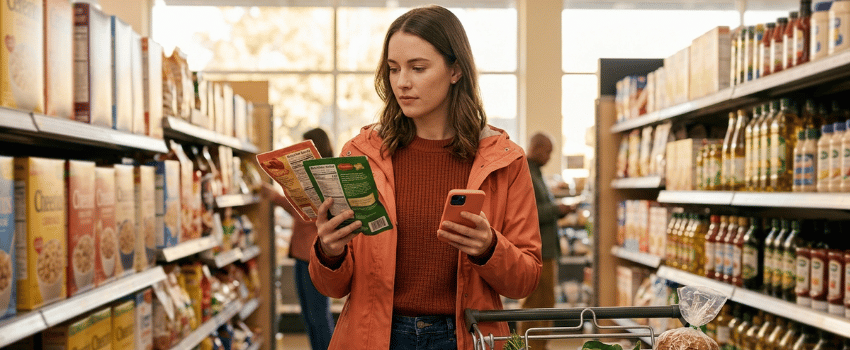
- 45% of consumers now make shopping lists before entering a store to avoid impulse purchases, up significantly from pre-inflation norms.
- 56% of US consumers said they would shop less overall if prices kept rising, and 75% would delay purchasing an electronic device.
- 58% of US households had cut back on discretionary spending as of September 2025.
- 62% of consumers felt their financial situation was tighter than the previous year (Highlight Survey, 2025).
- Penn State research found that consumers tend to cut entire spending categories entirely rather than trading down within a category, a pattern researchers call “preference refinement.”
The behavioral shifts cluster into a few clear patterns. Shoppers are trading down to cheaper brands. They’re postponing big-ticket purchases. And they’re switching stores to find lower prices. What’s interesting is that many of these habits haven’t snapped back even as headline inflation has moderated.
Penn State’s Smeal College of Business documented this preference refinement effect: when budgets get squeezed, people don’t just buy a cheaper version of the same thing. They cut the category entirely. Dining out disappears from the budget before the restaurant choice changes. Streaming subscriptions get canceled outright. Cheaper tiers come later, if at all.
What most guides miss is the stickiness of these habits. From tracking deal usage across thousands of stores, a clear pattern keeps showing up: coupon adoption spikes during high-inflation periods, then stays elevated even after inflation cools. Shoppers learn they can save real money without much effort. So they keep doing it. The behavioral shift from reactive to habitual is one of the more durable effects of the 2021-2023 inflation surge.
Grocery Shopping and Food Inflation Statistics
Food was the category that hit hardest and fastest. US grocery prices rose 32.7% between January 2020 and late 2024 according to BLS Food-at-Home CPI data. That’s not a rounding error. A $200 weekly grocery run in 2020 now runs closer to $265.
Food and Grocery Statistics
- Food-at-home prices rose 11.4% in 2022 alone, the steepest single-year grocery price increase since the early 1980s.
- Food price inflation slowed to 5.8% in 2023 and 2.3% in 2024, but cumulative grocery price increases since 2020 total roughly 23-25%.
- BLS 2024 review: food at home rose 1.8% year-over-year while food away from home rose 3.6%, meaning restaurant prices kept climbing faster than store prices.
- The average US household spent $10,169 on food in 2024, per the BLS Consumer Expenditure Survey.
- Out-of-home dining fell 23% as consumers shifted to home cooking to offset food cost increases.
- 75% of consumers said they’d delay an electronic device purchase due to inflation, but only 36% said they’d buy fewer groceries, showing how non-negotiable food spending is.
- UK supermarket volumes fell 9.4% for meat, fish, and poultry, 8.1% for household items, and 6.4% for packaged groceries during peak UK inflation.
Here’s the food inflation story by year. The USDA Economic Research Service tracks this closely:
| Year | Food-at-Home CPI Annual Change (%) |
|---|---|
| 2020 | +3.5% |
| 2021 | +3.5% |
| 2022 | +11.4% |
| 2023 | +5.8% |
| 2024 | +2.3% |
Source: USDA ERS, 2025.
The 2022 spike was the shock. 11.4% in a single year. Even after it slowed, prices kept rising on top of an already-high base. So by 2024, when grocery inflation reached a “normal” 2.3%, consumers were already four years deep into compounding increases. Restaurant prices kept climbing faster than grocery stores. That’s why out-of-home dining dropped 23% while home cooking surged.
💡
Tip: Use unit pricing (price per ounce or per serving) when comparing grocery items. Shrinkflation makes package sizes smaller while keeping sticker prices the same, so the sticker price alone is often misleading.
The Private Label Revolution: Store Brand Adoption During Inflation
Store brands had a breakout era during the inflation surge. US store brand sales hit a record $282.8 billion in 2025, a 3.3% increase over 2024, according to PLMA data. That’s not a temporary blip. Private labels now command 21.3% of dollar share and 23.5% of unit share in the US market.
Private Label Statistics
- 99% of US households purchased at least one private label grocery or health and beauty item in 2024, per Numerator data.
- 72% of consumers are now buying private label products over national brands.
- 54% of consumers surveyed said they plan to increase private label purchases going forward.
- NielsenIQ data shows private label unit sales rose 19.3% in September 2023 as CPG price hikes eased to 3.7%.
- 40% of European consumers tried a private label brand during the inflation period.
- Walmart’s private brand penetration growth rate doubled in food categories in Q2 2022 vs. Q1 2022.
- 27-31% of consumers are willing to substitute quality for savings on toiletries and packaged foods.
The private label shift is one of the clearest structural changes from the inflation era. Before 2020, store brands were mostly a budget shopper’s pick. Now 99% of US households buy them. That’s not a niche preference. It’s the default.
Part of what’s keeping store brand loyalty high is quality perception. Numerator’s 2024 data found that 65% of consumers believe private label products provide real value, not just cheap substitutes. Over half of BCG’s respondents planned to keep buying more store brands going forward. The brand-switching that happened during peak inflation is partly sticking.
And here’s something worth knowing: private label items often have coupons too, especially at major grocery chains and pharmacies. Combining a store-brand switch with a coupon can compound the savings quickly.
Where Americans Are Shopping: Channel Switching Statistics
Price sensitivity doesn’t just change what people buy. It changes where they buy it. 30% of shoppers who switched from their preferred retailer cited price increases as the primary reason, per BCG’s 2024 surveys.
Shopping Channel Statistics
- 30% of shoppers switched retailers primarily because of price increases.
- 30% of consumers would switch to a different retailer for better prices, while only 18% would switch for improved product selection.
- Retail foot traffic grew 2.3% year-over-year as of late 2025, with value-oriented destinations (discount stores, club stores) leading that growth.
- 44% of consumers now invest more time comparing prices online or using deal-hunting apps, rising to 60% for electronics shoppers.
- 45% of consumers now make shopping lists before entering stores to avoid unplanned purchases.
- Consumers are directing more spending to Aldi, Costco, Walmart, and dollar stores, all of which gained market share during the inflation surge.
The channel-switching story is partly about discount stores and warehouse clubs. Yale’s business school documented how Costco uses small gasoline discounts to drive more overall shopping trips. Gas prices were up 50% during the 2022 peak. Shoppers already there for gas became full-basket grocery shoppers while they were at it.
Aldi, Lidl, and dollar store formats gained share for simpler reasons. A smaller selection. Mostly private-label products. Prices that beat conventional supermarkets. That combination looks a lot better when a family is paying 19% more than they were for groceries a few years back.
Online price comparison also surged. 44% of consumers are spending more time comparing prices online before buying, with 60% doing so for electronics. That habit developed during inflation and hasn’t gone away. Tracking deals across hundreds of stores, the pattern we’ve seen is that shoppers who started using price comparison tools in 2022 and 2023 are still active users even as headline numbers ease.
Discount Hunting and Coupon Usage During Inflation
The most direct consumer response to inflation, at least for deal-conscious shoppers, has been a surge in coupon and discount code usage. 78% of respondents in one 2025 survey said they increased their use of coupons and promo codes, with inflation as the primary cited reason. That’s a majority of the shopping population actively hunting for savings.
Coupon and Discount Usage Statistics
- 78% of consumers increased coupon and promo code usage, citing inflation as their primary motivation (InsightsNewsWire, 2025).
- 54% of US online shoppers increased coupon usage in the prior 12 months, with 74% citing inflation or cost-of-living pressures as the motive.
- 26% of US adults reported using coupons more frequently than the prior year.
- 53.4% of all redeemed coupons in 2024 were digital, and an estimated 169.2 million Americans used digital coupons in 2025.
- 71% of consumers switched brands specifically because of a coupon or discount code.
- Nearly 40% of shoppers made more sale-driven purchases in the six months prior to BCG’s 2024 survey.
- 35% of shoppers would have delayed or canceled a purchase entirely without a discount.
The digital coupon numbers are striking. More than half of all coupons redeemed in 2024 were digital. And 169.2 million Americans used digital coupons in 2025. That’s more than half the US population. Big shift from just a few years earlier.
BCG’s data adds another dimension: 85% of department store shoppers and 65% of supermarket shoppers took advantage of promotional deals on their most recent trip. Promotions have gone from a nice-to-have to an expected part of the shopping experience. And 35% of shoppers say they would have delayed or canceled a purchase without a discount available.
🤔
Did You Know: 71% of consumers switched brands because of a coupon or discount code, meaning inflation-era couponing isn’t just saving money on planned purchases. It’s actively redirecting where those purchases happen.
Tracking coupon usage across our platform during the 2022-2024 inflation surge, categories like grocery staples, personal care, and household supplies saw the biggest spikes in coupon search activity. But here’s what stood out: after shoppers found working codes for the first time in a category they’d never couponed before, a large share kept coming back. Inflation introduced a lot of new coupon users to the habit. Those users didn’t leave when prices stabilized.
Inflation Impact by Income Group: Who Gets Hit Hardest
Inflation doesn’t affect everyone equally. Lower-income households spend a larger share of their income on food and energy, the two categories that saw the highest price increases during the 2021-2023 inflation surge. That structural difference means a 9% inflation rate hits differently depending on how much of your budget already goes to essentials.
Inflation by Income Group Statistics
- After inflation peaked in June 2022, households in the bottom 40% of the income distribution consistently experienced both higher inflation AND higher wage growth than middle and upper income groups (Cleveland Fed, 2025).
- The Dallas Fed (2023) found that low-income families were hurt more by inflation than higher-income families.
- The BLS documented that inflation experiences differ significantly between income groups because lower-income households have different consumption baskets, with a higher share going to necessities.
- 62% of consumers felt their financial situation was tighter than the prior year (Highlight Survey, 2025).
- 47% of consumers reported that high prices are actively eroding their personal finances (University of Michigan, March 2026).
- Lower-income households are also less likely to own inflation-hedging assets like real estate, which compounds the financial impact of sustained price increases.
The Cleveland Fed’s 2025 analysis found something worth pausing on. After the inflation peak in mid-2022, households in the bottom 40% saw higher wage growth alongside higher inflation. The picture is complicated. Wage growth for lower-income workers did pick up during the post-pandemic labor market. But those same households were spending a larger share of income on the categories that inflated most.
The Dallas Fed’s research is less ambiguous. Low-income families got hurt more. They have less budget flexibility. When food costs 11% more and you spend 25% of your income on food, that’s a real hit. A wealthier household spending only 8% on food feels the same price increase much less.
Generational Differences: How Gen Z, Millennials, and Boomers Shop During Inflation
Every generation has adjusted to inflation, but they’ve adjusted differently. Baby Boomers are 78% more likely than Gen Z to purchase items on sale, per Jungle Scout data. That’s not because Boomers are more price-conscious by nature. It’s partly because they have more spending history and more familiarity with sales cycles.
Generational Shopping Statistics
- Baby Boomers are 78% more likely than Gen Z to purchase items on sale.
- Millennials are nearly twice as likely as Baby Boomers to have unstable household income, making inflation hits harder to absorb.
- 56% of Gen X consumers are cutting back on impulse purchases, compared to 43% of Millennials.
- Gen Z is more likely than other generations to buy used or resale products in response to inflation, and less likely to rely on traditional sale-price shopping.
- 40% of consumers across all generations still intend to splurge on small treats or experiences like concerts and travel, the classic “lipstick effect” behavior.
- Gen Z and Millennial share of total consumer spend grew to 32%, up 8 percentage points vs. 2020.
The generational split is real but nuanced. Gen Z grew up with resale apps as mainstream. Buying used and hunting secondhand is just shopping to them, not a compromise. Inflation reinforced that behavior. It didn’t create it.
Millennials are carrying the most financial complexity. More likely to have unstable income. More likely to be in peak spending years for housing and kids. So while 43% are cutting impulse purchases, many are still spending on experiences and small treats. Life doesn’t pause for inflation.
And the lipstick effect is alive across all generations. McKinsey’s research found that 40% of consumers still plan small splurges on concerts, travel, or treats despite tight budgets. People don’t give up all enjoyment in hard times. They get more selective about where it comes from.
Category-by-Category Spending Changes During Inflation
Not every spending category responds to inflation the same way. Essentials hold steady or even grow; discretionary categories take the cuts. The data breaks down clearly by category.
Category Spending Statistics
- Electronics and office supplies saw the sharpest consumer cutbacks of any retail category during the inflation period.
- Essential categories, specifically groceries, pet food, and healthcare, were largely protected from consumer cutbacks.
- Housing expenditures rose 3.3% in 2024, following a 4.7% increase in 2023, and housing plus transportation together account for 50% of total household spending.
- Total US retail sales grew 3.7% to $7.45 trillion in 2025 despite ongoing price pressure, suggesting consumers are still spending but being more selective.
- 32% of consumers switched to lower-priced grocery brands in early 2026.
- Out-of-home dining fell 23% as home cooking became the primary cost-control mechanism in the food category.
The table below summarizes spending behavior across major categories based on BCG survey data and BLS Consumer Expenditure figures:
| Category | Consumer Response | Key Trend |
|---|---|---|
| Groceries / Food at Home | Maintained volume; brand-switching to private labels | 32% switched to cheaper brands (NIQ, 2026) |
| Dining Out | Sharp cutbacks | Down 23% vs. pre-inflation norm |
| Electronics | Purchase delays; sharpest discretionary cuts | 75% delayed electronics purchase (Morning Consult) |
| Apparel | Off-price and value retail gained share | Shoppers shifted to TJ Maxx, Ross, and outlet stores |
| Housing | Unavoidable; rose 3.3% in 2024 | Housing + transport = 50% of household budget (BLS) |
| Healthcare | Largely non-discretionary; maintained | Small treats and self-care preserved in most budgets |
| Entertainment / Experiences | Selective splurging | 40% still plan small treats; concert and travel spending held |
The K-shaped retail market tells the story clearly. Essential categories and premium experiences both hold up. The middle gets squeezed. Full-price apparel, mid-range electronics, and discretionary home goods saw the most damage. That’s where the deals space becomes most relevant. Price-conscious shoppers in those categories are actively searching for coupons and markdowns before committing.
Shrinkflation: The Hidden Price Increase
Shrinkflation is when a manufacturer reduces the quantity or size of a product while keeping the price the same. It’s a stealth price increase that doesn’t show up in the sticker price but hits your wallet just the same.
Shrinkflation Statistics
- Shrinkflation has been documented across snack foods, cleaning products, personal care items, and paper goods, the categories most affected by input cost increases.
- Yale’s business school cited Costco’s donut hole pricing as a textbook example: manufacturers charge the same price while quietly reducing quantity.
- Consumer awareness of shrinkflation rose significantly through 2023-2025, with a growing share of shoppers reporting they noticed package size reductions.
- Some consumers respond to detected shrinkflation by switching brands; others report fatigue and continue purchasing out of habit.
- The most effective defense against shrinkflation is unit price comparison: price per ounce, per sheet, or per serving makes the real cost transparent regardless of package size.
Shrinkflation isn’t new, but it spiked during 2021-2023 when input costs hit virtually every manufactured product. Manufacturers had two options. Raise visible prices (which shows up in comparison shopping and can trigger brand-switching). Or quietly reduce what’s in the package. Many chose the second option.
The defense is simple. Check unit pricing, not total price. Most grocery stores show price-per-ounce or price-per-unit on the shelf label. That’s the number that matters. Compare it across sizes and brands. And for products you buy regularly, notice if the package feels lighter. That’s shrinkflation in action.
Online Shopping and E-Commerce During Inflation
E-commerce shopping adapted to inflation in a few specific ways. Shipping costs became a major friction point. 52% of consumers refuse to pay for shipping, and 70% would switch retailers over a $1-$5 shipping cost difference. When you’re already paying more for everything, an avoidable $6.99 shipping charge feels like a tax.
E-Commerce and Online Shopping Statistics
- 52% of consumers refuse to pay for shipping, and 70% would switch to another retailer over a $1-$5 shipping cost difference.
- Black Friday online sales grew 9% year-over-year in 2025, with US consumers spending $11.8 billion online on Black Friday 2025 alone (Adobe Analytics).
- Digital coupon usage in e-commerce surged during the inflation period, with 53.4% of all redeemed coupons in 2024 being digital.
- 44% of consumers invest significantly more time comparing prices online before purchasing, with electronics shoppers doing so at a 60% rate.
- Gen Z is most likely to buy used or resale products online in response to inflation, using platforms for secondhand goods more than any other generation.
- Free shipping has become a decisive purchase factor: inflation-era shoppers treat unexpected shipping costs as a reason to abandon the cart.
The Black Friday 2025 numbers ($11.8 billion in a single day) show that online shopping isn’t retreating. But how consumers approach those purchases has changed. They’re researching longer, comparing more tabs, and looking for free shipping thresholds before adding to cart.
Shipping cost sensitivity is one of the cleaner behavioral signals from the inflation era. Free shipping used to be a nice perk. For a significant share of shoppers, it’s now a purchase requirement. Retailers that offer free shipping thresholds see higher conversion; those that add shipping fees at checkout see higher abandonment. The free shipping coupon or promo code is one of the most-searched deal types on our platform, and that usage pattern intensified markedly starting in 2022.
The Inflation-Proof Shopping Playbook
You can’t control inflation. But you can build shopping habits that offset its impact. The shoppers who’ve consistently gotten the most value out of high-price environments combine several strategies that, stacked together, can effectively counter 10-15% of inflation’s impact on a household budget.
Stack coupons and cashback. Most major retailers allow a promo code alongside cashback offers. A 15% promo code plus 5% cashback adds up fast. Tools like the DontPayFull Chrome extension test available codes automatically at checkout, so you don’t have to search manually.
Compare unit prices, not sticker prices. For groceries and household products, the per-unit or per-ounce price tells you what you’re actually paying. Sticker price alone is unreliable when shrinkflation is in play.
Switch categories, not just brands. If dining out has gotten too expensive, cutting it entirely and cooking at home often saves more than finding a cheaper restaurant.
Time major purchases. Electronics, appliances, and home goods follow predictable sale cycles. Buying an off-season item saves 20-40% versus peak pricing. Air conditioner in October. TV after the Super Bowl. It just takes patience.
Use store brand products where quality is comparable. For commodity categories like cleaning supplies, paper goods, and basic pantry staples, DontPayFull tracks deals across national and store brands. In many categories, the private label version comes from the same manufacturer as the national brand, just with a different label.
Free shipping as a baseline, not a bonus. Build your shopping around stores and promotions that include free shipping. Factor shipping costs into any price comparison. A cheaper item that ships for $8 often costs more than a slightly pricier item that ships free.
Methodology
This article compiles data from multiple categories of sources to provide a comprehensive view of how inflation has affected shopping behavior in the United States.
A note on data currency: Government statistical agencies typically publish annual survey results 12-18 months after the reference year closes. As of 2026, the most recent BLS Consumer Expenditure Survey covers 2024 data (released in 2025), and the BLS CPI annual review covers calendar year 2024. Where data refers to 2024 or earlier, it reflects the latest available release at the time of writing. Newer survey data from BCG, Numerator, NielsenIQ, and similar firms covers more recent fieldwork from 2024-2026, as noted per citation.
Primary government and institutional sources:
- Bureau of Labor Statistics (BLS) Consumer Price Index and Consumer Expenditure Survey
- USDA Economic Research Service (ERS) food price inflation tracking
- Bureau of Economic Analysis (BEA) consumer spending data
- Federal Reserve Board and regional Fed research (Cleveland, Dallas)
Research and survey sources:
- BCG Spring 2024 consumer surveys (channel switching, private label, deal-hunting behavior)
- JPMorgan Research 2022 (inflation cost-of-living analysis)
- Numerator 2024 (private label household penetration)
- NielsenIQ 2023 (CPG price change and private label unit sales)
- PLMA (Private Label Manufacturers Association) 2025 (store brand sales data)
Date range: Data spans 2019 through March 2026, with most behavioral statistics from 2022-2025.
Limitations: Consumer survey data from consulting firms may have sampling biases. Regional data is primarily US-focused, with UK/European data included for context on specific metrics. Survey-based data reflects stated intent, which may differ from actual purchase behavior.
Data compiled by the DontPayFull Research Team based on publicly available data from government agencies, academic institutions, and industry research firms.
The Bottom Line
Inflation reshaped US shopping behavior in ways that haven’t fully reversed even as headline CPI has moderated. Grocery prices are still roughly 32% above 2020 levels, and the habits consumers built to cope, buying private labels, hunting for deals, switching stores, and comparing prices obsessively, have become defaults. If you’re looking to offset inflation’s ongoing bite, the most effective approach combines store brand switching (savings of 15-30% on compatible categories), digital coupon stacking, free shipping prioritization, and timing big purchases around predictable sale cycles. Used together, these strategies can recover a meaningful share of what inflation has taken from purchasing power.
FAQ
How does inflation affect consumer purchasing behavior?
Inflation reduces purchasing power, so consumers typically buy less, switch to cheaper alternatives, delay non-essential purchases, and become more active deal hunters. BCG’s 2024 surveys found that two-thirds of US consumers were buying less or choosing cheaper alternatives during the sustained inflation period.
What do consumers buy less of during inflation?
Discretionary categories take the biggest hits. Electronics, dining out, and full-price apparel see the sharpest cutbacks. About 75% of consumers said they’d delay an electronic device purchase during inflation, while only 36% said they’d reduce grocery purchases, reflecting how essential food spending is compared to discretionary goods.
Has inflation permanently changed shopping habits?
Much of it looks permanent. Private label adoption is at historic highs (99% household penetration), digital coupon usage has doubled from pre-inflation levels, and price comparison has become a default behavior for nearly half of consumers. These aren’t temporary recession habits. They’re sticky behavioral changes that researchers at CSUN documented are persisting even as headline inflation moderates.
Which stores offer the best value during inflation?
Discount grocery formats (Aldi, Lidl), warehouse clubs (Costco, Sam’s Club), and off-price apparel retailers (TJ Maxx, Ross, Marshalls) gained market share during the inflation period because they structurally offer lower prices. Dollar stores also gained traffic, though unit price comparisons sometimes show conventional stores are competitive on specific items.
How can coupons and deals help fight inflation?
Coupons and promo codes directly offset price increases at checkout. 78% of shoppers increased coupon usage because of inflation, and 35% would have canceled or delayed purchases without a discount. The combination of store-brand switching plus coupon stacking plus cashback can reduce effective spending by 15-30% in many retail categories.
What is shrinkflation and how can I avoid it?
Shrinkflation is when manufacturers reduce product size or quantity while keeping the price the same, a hidden price increase. The best defense is checking unit pricing (price per ounce, per sheet, or per serving) rather than total package price. Most grocery stores display unit prices on shelf labels. Comparing unit prices makes shrinkflation immediately visible.
How do different generations respond to inflation differently?
Baby Boomers are 78% more likely than Gen Z to buy on sale. Gen Z leans more toward secondhand and resale purchases. Millennials are cutting impulse buys (43% doing so) and face the highest income instability. Gen X has the highest impulse purchase cutback rate at 56%. All generations show some version of the lipstick effect, protecting small indulgences and experiences while cutting bigger discretionary spending.
Do lower-income households get hit harder by inflation?
Yes, structurally. Lower-income households spend a larger share of income on food and energy, the two categories with the highest inflation during 2021-2023. The Federal Reserve, Dallas Fed, and BLS have all documented that inflation hits lower-income households harder due to their consumption basket composition. However, the Cleveland Fed found that after the June 2022 peak, bottom-40% households also saw higher wage growth, partially offsetting the impact.
Sources
- Bureau of Labor Statistics – Consumer Price Index 2024 in Review: Annual CPI data, food-at-home and food-away-from-home changes (2024)
- USDA Economic Research Service – Food Price Inflation Slowed in 2023 and 2024: Annual food-at-home price changes 2020-2024
- BCG – Inflation Changed Consumers, Time to Rethink Pricing: Spring 2024 consumer survey data on shopping behavior, channel switching, private label, promotions
- Yale Insights – How Does Inflation Change Consumer Behavior?: Expert analysis on inflation psychology and behavioral responses
- Penn State Smeal – What Does Inflation Reveal About Consumer Preferences?: Preference refinement theory research
- Cleveland Fed – Did Inflation Affect Households Differently?: Income-group differential inflation and wage growth analysis (2025)
- Dallas Fed – Low-Income Families and Inflation: Research on disproportionate inflation impact on lower-income households (2023)
- Federal Reserve Board – Inflation and Household Finances: Speech on inflation impact by income level (2022)
- BLS – Inflation Experiences for Lower and Higher Income Households: Different consumption baskets by income level
- JPMorgan – Inflation and the Cost of Living: Global research on consumer spending under inflation (2022)
- Investopedia – Top 10 Effects of Inflation: Comprehensive inflation effects reference
- CSUN – Consumers Changing Their Behavior as Inflation Persists: Expert commentary on persistent behavioral changes post-peak inflation (2024)
Do You Have Any Suggestions?
We're always looking for ways to enrich our content on DontPayFull.com. If you have a valuable resource or other suggestion that could enhance our existing content, we would love to hear from you.
Was this content helpful to you?
Related Articles